

First Software Development Internship: What Freshers Should Learn Before Applying
First Software Development Internship: What Freshers Should Learn in 2026
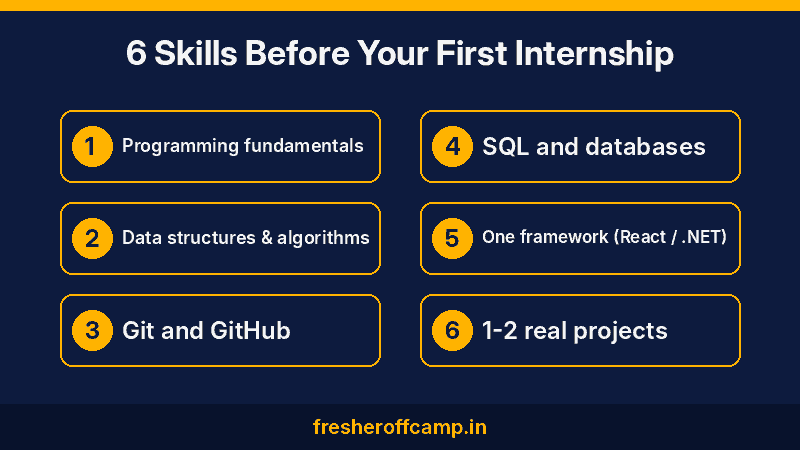
Software Development Internship preparation needs six things: one programming language you know well, basic data structures and algorithms, Git and GitHub, SQL and database basics, one framework such as React or .NET, and one or two projects you built yourself. Companies do not expect an intern to know everything. They check your basics and how fast you learn.
This guide is for students and freshers who know a little programming but have never worked in a company and want a software development internship. It gives the order in which to learn each skill, how deep to go, and a 12-week plan you can follow alongside college. Last updated: 13 November 2026.
Quick Summary: Skills for a Software Development Internship
| Skill | What to learn | Suggested time |
|---|---|---|
| Programming fundamentals | One language: variables, loops, functions, OOP, error handling | 3 weeks |
| Data structures and algorithms | Arrays, strings, hash maps, stacks, queues, recursion, sorting | 3 weeks, then daily practice |
| Git and GitHub | Clone, branch, commit, push, pull request, merge conflicts | 1 week |
| Databases | SQL queries, joins, keys, basic table design | 1 week |
| One framework | React, .NET, Spring Boot, Django or Node.js | 2 weeks |
| Projects | One or two working projects on GitHub | 2 weeks or more |
The time column assumes about two hours of study a day.
Read Also:-
NetApp Off Campus 2026 Hiring Fresher For Sales Analyst | Bengaluru:- CLICK HERE
HCL Recruitment 2026: 5 Latest Fresher Job Opportunities:- CLICK HERE
Table of Contents
- What Companies Expect From Interns
- Software Development Internship Roadmap: 6 Skills
- 12-Week Preparation Plan
- Workplace Skills for Your First Internship
- How to Apply for a Software Development Internship
- Common Mistakes Freshers Make
- Frequently Asked Questions
- Final Words
What Companies Expect From a Software Development Internship Candidate
In a software development internship, you are hired to learn and to help with small tasks. Nobody expects you to design a full system in the first month. What interviewers want to see is that you can write working code, explain it, and pick up new tools without someone sitting next to you all day.
Intuit’s guide on how to get a software engineering internship puts the technical foundation first. It advises students to become fluent in at least one programming language and to study data structures and algorithms before they apply.
If you read a few internship listings on any job portal, the same words come up again and again: programming fundamentals in Python, Java or C++, problem solving, Git, SQL, and one web framework. Many listings mark Git and databases as preferred skills, so knowing them puts you ahead of applicants who only know syntax.
Selection for a software development internship usually has a coding test or assignment and one or two interviews. The test checks DSA and basic programming. The interview is mostly about your projects.
Software Development Internship Roadmap: 6 Skills to Learn in Order
Follow this software development internship roadmap in order. Each step uses what you learned in the step before it, and jumping straight to a framework is the most common reason beginners get stuck.
Step 1: Programming fundamentals in one language
Pick one language and stay with it. Python is the easiest to start with, Java and C++ are common in college placements, and JavaScript is needed for web work. Any of them is accepted in most coding tests.
- Variables, data types, operators and input/output
- Conditions, loops and functions
- Arrays or lists, strings and dictionaries or maps
- Object oriented programming: classes, objects, inheritance
- File handling and error handling
- Reading an error message and fixing the bug yourself
You are ready for the next step when you can write a 50-line program, such as a simple calculator or a student record manager, without copying from a tutorial.
Step 2: Data structures and algorithms
DSA is what the coding round tests. For a first internship you do not need advanced topics. Start with arrays, strings, hash maps, stacks, queues and linked lists. Then learn recursion, binary search and the common sorting methods.
Solve one or two problems every day on a practice site such as LeetCode, HackerRank or GeeksforGeeks. Stay on easy problems until you can solve most of them in 20 minutes, then move to medium ones. If product companies are your target, add trees, graphs and dynamic programming later.
Step 3: Git and GitHub
Every team keeps its code in Git, and this is the skill college labs usually skip. You need a small set of commands: clone, status, add, commit, push, pull, branch and merge. Learn how to raise a pull request and how to fix a merge conflict, because you will do both in your first week as an intern.
The fastest way to learn Git is to use it for everything. Push your DSA solutions and your practice programs to GitHub from today. After two months your profile will show regular activity, and recruiters do open GitHub links on a resume.
Step 4: Databases and SQL
Almost every application stores data, so interns are often asked to write or fix queries. Learn SQL on MySQL or PostgreSQL: SELECT, WHERE, ORDER BY, GROUP BY, joins, and insert, update and delete statements. Understand primary keys, foreign keys and how to split data into tables.
Step 5: One framework (React, .NET or another)
A framework is how real applications get built. Learn one, and choose it by the kind of role you want.
| If you want | Learn | Also needed |
|---|---|---|
| Frontend or full stack web roles | React | HTML, CSS, JavaScript |
| Enterprise and service company roles | ASP.NET Core or Spring Boot | C# or Java, SQL |
| Backend with Python | Django or Flask | Python, SQL, REST APIs |
| JavaScript on both sides | Node.js with Express | JavaScript, MongoDB or SQL |
At intern level, the basics are enough: routing, forms, calling an API, and connecting to a database. If you want the complete web path, our full stack developer roadmap covers it step by step.
Step 6: Projects for a software development internship
Projects are your proof of work. A good project solves a small real problem, stores data in a database, and runs without errors. It should have a login or some user input, a README that explains how to run it, and a commit history that shows you built it over time.
Ideas that work well: an expense tracker, a job application tracker, a library or hostel management app, a notes app with search, or a simple REST API for a shop. Take a tutorial project only as a starting point and add two or three features of your own. Deploy it on a free hosting service if you can, so the interviewer can open a link.
12-Week Software Development Internship Preparation Plan
This sample plan fits a student who can give about two hours on weekdays and a little more on weekends. If you already know a language well, skip the first three weeks.
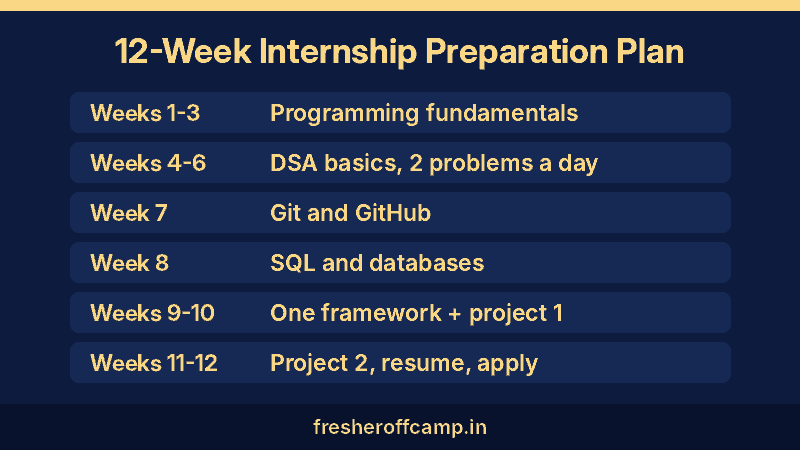
| Weeks | Focus | Target |
|---|---|---|
| 1 to 3 | Programming fundamentals | Finish core topics and write small programs daily |
| 4 to 6 | DSA basics | Arrays, strings, hashing, stacks, queues, recursion, sorting; two problems a day |
| 7 | Git and GitHub | Push all earlier code; practise branches and one pull request |
| 8 | SQL and databases | Queries, joins and a small schema for your project |
| 9 to 10 | One framework | Learn the basics and build project 1 |
| 11 to 12 | Project 2 and applications | Polish, deploy, write README files, update your resume and start applying |
Keep solving one DSA problem a day from week 7 onwards, because the coding test in a software development internship drive rewards regular practice.
Workplace Skills for Your First Software Development Internship
Technical skills get you selected. A few working habits decide how the internship goes after that. In GitHub’s article on preparing for your internship, one former intern says his first internship made it easier to get the next ones and later a job offer.
- Ask questions early. Spend 20 to 30 minutes trying on your own, then ask a teammate with details of what you tried.
- Take notes. You will hear new tool names, setup steps and project terms every day in the first two weeks.
- Read other people’s code. Most intern work is changing existing code, so practise by reading open source projects on GitHub.
- Learn basic debugging. Use print statements, the debugger and logs before you ask for help.
- Know the words used in Agile teams: sprint, daily standup, ticket and code review.
- Write clear messages. A short update that says what is done, what is pending and what is blocking you saves everyone time.
How to Apply for a Software Development Internship
Start applying when you have one finished project and can solve easy DSA problems comfortably. Waiting until you feel fully ready usually means missing the hiring window, because large companies open internship applications months before the start date.
- Make a one-page resume with education, skills, projects and your GitHub and LinkedIn links.
- For each project, write what it does, the tech stack and one specific thing you built in it.
- Apply on company career pages first, then on LinkedIn and internship portals.
- Ask seniors and alumni for referrals. A short, polite message with your resume attached works better than a long one.
We post verified internship and fresher openings on the Fresheroffcamp.in homepage every day. Recent examples are the IBM Research Software Intern opening and our Microsoft internship guide. Before the interview, go through the Interview Kit for common technical and HR questions, and see our job hunt resources for freshers for resume and job search toolkits.
A genuine company never asks you to pay for an internship offer, training or a laptop. If someone asks for money, stop there and check the opening on the company’s official careers page.
Common Mistakes Freshers Make Before a Software Development Internship
- Learning three languages at a basic level instead of one language properly.
- Starting React or .NET before they can write a loop or a function with confidence.
- Copying a project from YouTube and failing to explain it in the interview.
- Ignoring Git until the first day of the internship.
- Applying to only five or six big companies and ignoring startups and mid-size firms.
- Stopping DSA practice once project work begins.
If your applications are going out but replies are not coming, read our post on why freshers get no interview calls. Most of the reasons there apply to a software development internship application too.
Frequently Asked Questions
What should a fresher learn before a first software development internship?
Learn one programming language well, basic data structures and algorithms, Git and GitHub, SQL, and one framework. Then build one or two projects with these skills and put the code on GitHub. That is enough to apply for a beginner software development internship.
How much DSA is needed for a software development internship?
For most internships, basic to medium level DSA is enough. Cover arrays, strings, hash maps, stacks, queues, linked lists, recursion, sorting and searching. Product companies ask harder questions, so add trees, graphs and dynamic programming if you are targeting them.
Which programming language is best for a software development internship?
There is no single best language. Python, Java, C++ and JavaScript are all accepted in most coding tests. Pick the one taught in your college or the one used in your target role, and stay with it until you can solve problems without looking up syntax.
Is React or .NET better for a fresher?
Both are fine, and the right choice depends on the role you want. React suits frontend and full stack roles at startups and product teams. .NET with C# is common in enterprise and service companies. Learn one properly instead of learning both halfway.
Do I need projects to get a software development internship?
Yes, projects help a lot because a fresher has no work experience to show. One or two working projects with clean code on GitHub give the interviewer something real to ask about. Tutorial copies do not help much, so add your own features.
How long does it take to prepare for a first software development internship?
With about two hours of study a day, three months is a reasonable target to prepare for a software development internship for a beginner who already knows basic programming. Someone starting from zero may need four to six months. The time depends on how regularly you practise.
Can non-CS students apply for a software development internship?
Yes, many companies accept students from ECE, EEE, mechanical and other branches if they can code. Eligibility differs from company to company, so read the listing before applying. Projects and DSA practice matter more than the branch name in most interviews.
Is Git necessary for a software intern?
Yes. Almost every software team keeps its code in Git, so an intern who can create a branch, commit and raise a pull request can start contributing sooner.
Final Words
To prepare for a software development internship, learn one language, practise DSA, use Git daily, learn SQL, pick one framework and build two projects you can explain line by line. Three months of regular work is enough for most beginners. When your first project is ready, start applying through the latest off campus openings on our site.


Leave a Reply