

TCS NQT Pattern 2026: Sections, Questions, Time and Syllabus
The TCS NQT pattern decides how you should prepare. Many freshers spend weeks on topics that never appear, or ignore the coding section that decides whether they are considered for the better-paying Digital and Prime roles. This guide explains the current TCS NQT pattern section by section: how many questions, how much time, what is asked, and how to prepare for each part.
TCS NQT pattern at a glance
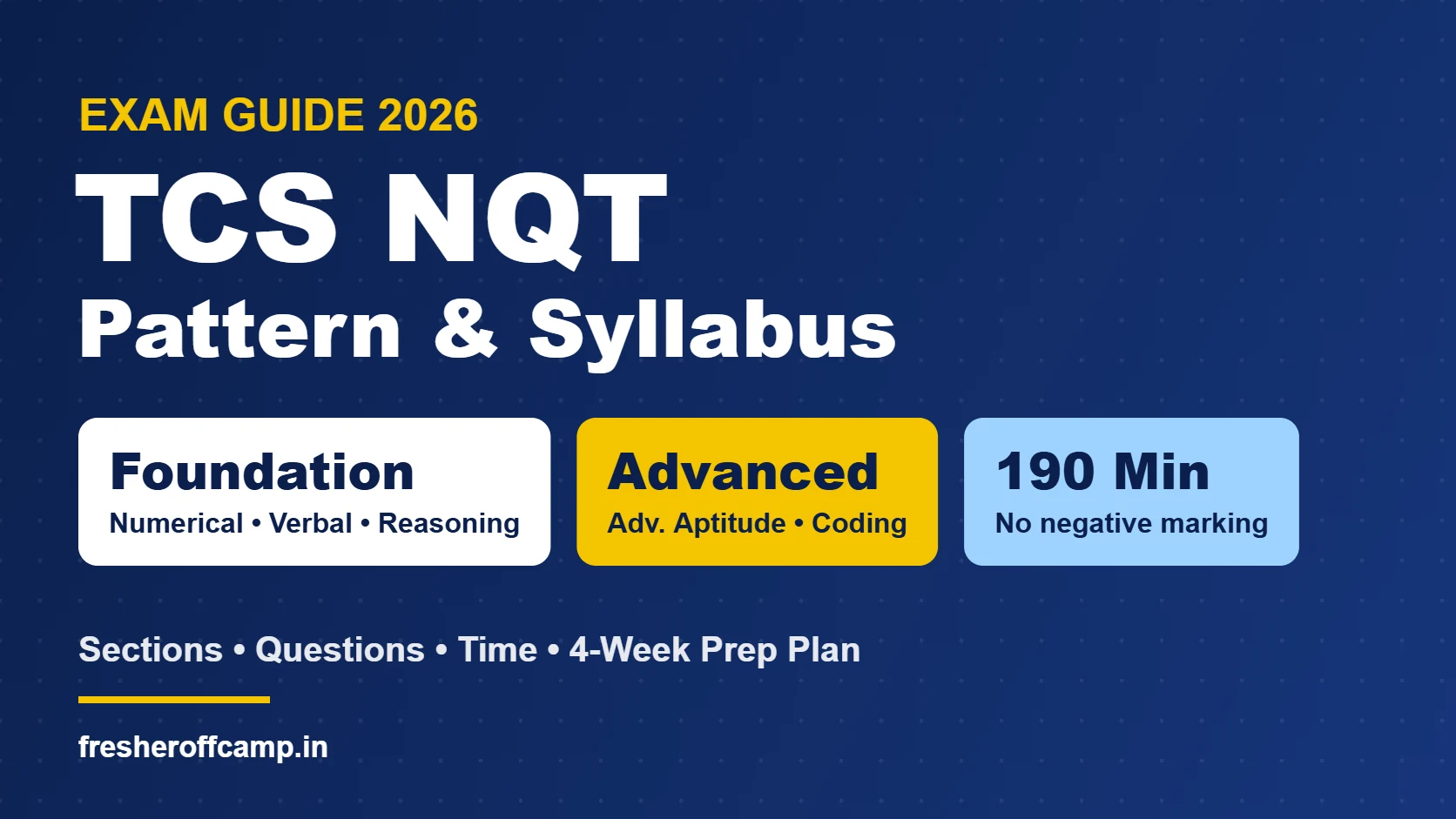
The TCS NQT used for TCS fresher hiring is one test of about 190 minutes with two parts. Part A (Foundation) is for everyone. Part B (Advanced) is what TCS uses to consider candidates for its Digital and Prime roles.
| Part | Section | Questions | Time |
|---|---|---|---|
| Part A: Foundation | Numerical Ability | 20 | 25 min |
| Verbal Ability | 25 | 25 min | |
| Reasoning Ability | 20 | 25 min | |
| Part B: Advanced | Advanced Quantitative + Advanced Reasoning | About 15 (10 + 5) | 25 min (shared) |
| Advanced Coding | 2–3 problems | 90 min | |
| Total | About 80–83 | About 190 min | |
These numbers come from recent TCS hiring cycles as reported by test-takers and preparation platforms. The number of coding problems has varied between cycles, which is why we show a range.
Key rules to remember
- No negative marking. A wrong answer scores the same as a blank one, so never leave a question unanswered.
- Each section has its own timer. You usually cannot go back to an earlier section once its time ends, so you cannot “save” time from verbal for numerical.
- Coding languages: C, C++, Java, Python and C# are commonly allowed in the coding section.
- English only. TCS iON states that NQT tests are conducted only in English.
How the pattern decides Ninja, Digital or Prime
You do not pick a role at registration. TCS decides which category you are considered for after the test, mainly from your scores:
| Category | What it mainly depends on |
|---|---|
| Ninja | A good score in Part A (Foundation) |
| Digital | Strong scores in both Part A and Part B, especially coding |
| Prime | Top scores in both parts, usually with fully solved coding problems |
TCS does not publish exact cut-offs, and they change with each cycle. The practical lesson is simple: Foundation gets you in, coding moves you up. Even if you are aiming only for Ninja, a reasonable attempt at Part B costs you nothing.
Read Also:-
How to Crack the TCS Ninja Interview:- CLICK HERE
TCS iON NQT 2026: How to Apply:- CLICK HERE
Part A: Foundation syllabus and tips
1. Numerical Ability (20 questions, 25 minutes)
About 75 seconds per question. Most questions are school-level maths asked quickly.
- Most important: percentages, profit and loss, ratio and proportion, time and work, speed-time-distance, averages, simple and compound interest.
- Also asked: number system, LCM and HCF, mixtures and alligation, ages, probability, permutations and combinations, data interpretation (tables, pie charts, graphs).
- Tip: learn squares up to 30 and the fraction–percentage table (1/8 = 12.5%, 1/6 = 16.67%, and so on). It saves several seconds on almost every question.
2. Verbal Ability (25 questions, 25 minutes)
One minute per question, which is the tightest section for many students.
- Topics: reading comprehension, sentence completion, error spotting, para-jumbles (sentence ordering), synonyms and word meaning, and choosing formal or correct sentences.
- Tip: for reading comprehension, read the questions first, then the passage. Do the short grammar questions before long passages.
3. Reasoning Ability (20 questions, 25 minutes)
- Topics: number and letter series, seating arrangement, blood relations, directions, syllogisms, statement and conclusion, data sufficiency, coding-decoding and visual reasoning (paper folding, cube, figure series).
- Tip: seating arrangement questions usually come in sets. If the first question of a set takes more than 3 minutes, mark a guess and move on, since there is no negative marking.
Part B: Advanced syllabus and tips
4. Advanced Quantitative and Reasoning (about 15 questions, 25 minutes)
Same topics as Foundation, but with multi-step questions: probability, permutations and combinations, algebra, geometry, compound interest, complex seating arrangements and symbol-based puzzles. Aim for accuracy on the ones you understand rather than speed on all of them.
5. Advanced Coding (2–3 problems, 90 minutes)
This is the section that separates Digital and Prime candidates. Problems are usually written as a short real-life story and test standard programming patterns:
- Arrays and strings: sorting, searching, frequency counting, palindromes, rotations.
- Maths-based logic: prime numbers, GCD, digit operations, number patterns.
- Harder problems: greedy approaches, basic dynamic programming, prefix sums, hashing.
Tips for the coding section:
- Read input exactly as specified. Many correct solutions fail only because of input or output format.
- Solve the easier problem first and submit it, then move to the harder one.
- Test edge cases: empty input, a single element, very large numbers, negative values.
- Partial test-case passes still count, so a working brute-force solution is better than an unfinished perfect one.
- Use one language you are comfortable with. Python is fast to write; C++ or Java help when time limits are strict.
4-week preparation plan
| Week | Focus | Daily target |
|---|---|---|
| Week 1 | Numerical Ability basics + 1 coding problem a day (arrays, strings) | 30 aptitude questions, 1 coding problem |
| Week 2 | Reasoning + Verbal, continue coding | 20 reasoning, 1 RC passage, 1–2 coding problems |
| Week 3 | Advanced quant and reasoning, harder coding (hashing, greedy, DP basics) | 15 advanced questions, 2 coding problems |
| Week 4 | Full timed mock tests and revision of mistakes | 1 full mock every 2 days, review every wrong answer |
Keep a single notebook of mistakes. Re-solving your own wrong answers in week 4 is more useful than attempting new questions.
TCS NQT vs TCS iON NQT: are they the same?
Students often mix these up.
- TCS NQT for TCS hiring is the test you take after registering for a TCS fresher drive on the TCS NextStep portal. The Foundation + Advanced pattern above applies here.
- TCS iON NQT is a separate paid assessment from TCS iON that many companies accept. According to the official TCS iON page, it is open to pre-final and final year UG, PG and diploma students and to people with under 2 years of experience, for 2021–2027 pass-outs aged 17 to 30. It is held only at TCS iON authorised centres, has no negative marking, and the score is valid for 2 years. You can retake it with no limit on attempts, but only 90 days after your last purchase, and your best score counts.
Check which one your invitation is for before you prepare, because the section names and timings can differ.
Common mistakes
- Skipping coding practice because you “only want Ninja”. Coding often decides Digital and Prime.
- Leaving questions blank. With no negative marking, always mark an answer.
- Never practising with a timer. Knowing the topic is not enough when you have about a minute per question.
- Paying an agent for “guaranteed selection”. TCS does not charge candidates to be hired. Register only on the official TCS NextStep or TCS iON websites.
FAQs
How many sections are there in TCS NQT?
Two parts. Part A (Foundation) has Numerical, Verbal and Reasoning Ability. Part B (Advanced) has Advanced Quantitative and Reasoning, plus Advanced Coding.
What is the total duration of TCS NQT?
About 190 minutes: 75 minutes for Foundation and 115 minutes for Advanced.
Is there negative marking in TCS NQT?
No. Wrong answers and unanswered questions both score zero.
Is coding compulsory in TCS NQT?
The coding section is part of Part B. For Ninja, the Foundation score matters most, but a good coding attempt is what makes you eligible for Digital and Prime.
Which programming languages are allowed?
C, C++, Java, Python and C# are commonly allowed. Check the language list shown in your test before you start.
How long is the TCS iON NQT score valid?
TCS iON states that the NQT score is valid for 2 years from the date the result is published.
Once you clear the test, prepare for the interview with our Interview Kit and the TCS Ninja interview guide. For current TCS openings, see our latest off campus jobs.
Sources: TCS iON National Qualifier Test (official); section-wise pattern as reported for recent TCS hiring cycles. Last updated: 21 October 2026.


Leave a Reply