


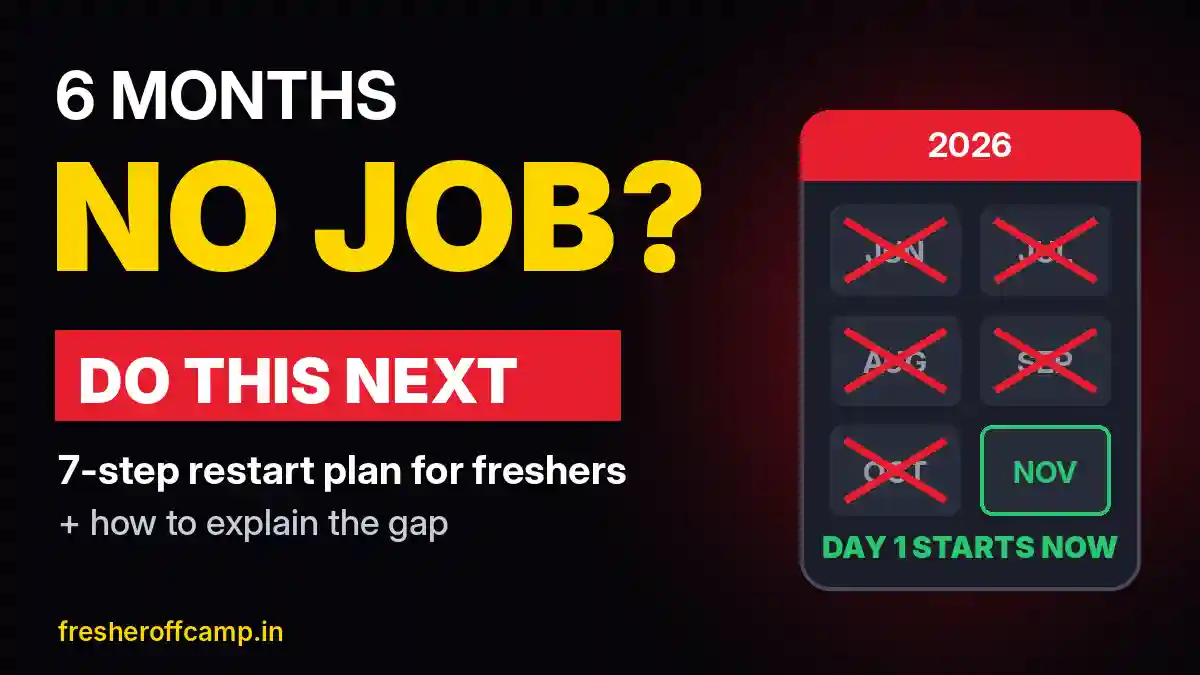
How to Find Your First Job After 6 Months of Unemployment
Finding Your First Job After 6 Months of Unemployment
To find your first job after 6 months of unemployment, stop doing more of what has not worked. Pick one target role, fill the gap with one visible project or short internship, rebuild your resume around it, and apply through career pages, LinkedIn and referrals instead of only job portals. Most freshers can restart properly in about 30 days.
Six months is long enough to feel stuck. Batchmates are posting joining photos and relatives keep asking “job lagi?” But a six-month gap after graduation is very common, and it is not a mark against you if you can show what you did with that time. Here is a step-by-step way to restart.
Last updated: 5 November 2026
Quick Overview: The Restart Plan
| Step | What to do | Time needed |
|---|---|---|
| 1 | Look back honestly at the last 6 months | 1 day |
| 2 | Choose one target role | 1-2 days |
| 3 | Fill the gap with one project or internship | 1-3 weeks |
| 4 | Rebuild your resume and profiles | 2-3 days |
| 5 | Change where and how you apply | Ongoing |
| 6 | Prepare a calm answer for the gap question | 1 day |
| 7 | Be open to a stepping-stone job | Decide early |
Important: The goal is not to apply to more jobs. The goal is to become a better match for fewer, well-chosen jobs.
Read Also:-
Unisys Off Campus 2026 Hiring Fresher Network Security Engineer | Bangalore:- CLICK HERE
ZS Off Campus 2026: Business Technology Solutions Associate Preparation Guide:- CLICK HERE
Table of Contents
- Step 1: Look Back Honestly
- Step 2: Choose One Target Role
- Step 3: Fill the Gap With Proof
- Step 4: Rebuild Your Resume and Profiles
- Step 5: Change Where You Apply
- Step 6: How to Explain the 6-Month Gap
- Step 7: Consider a Stepping-Stone Job
- 30-Day Restart Plan
- Frequently Asked Questions
Step 1: Look Back Honestly at the Last 6 Months
Before changing anything, find out what went wrong. Open your email, Naukri and LinkedIn history and answer these questions on paper:
- Roughly how many jobs did you apply to?
- How many calls, tests or interviews did you get?
- At which stage did you usually drop out: no reply, online test, HR round or technical round?
- Were you applying for one kind of role, or anything that said “fresher”?
Your answers point to the fix. No replies at all usually means a resume or role-fit problem. Failing tests means a skills gap. Failing interviews means you need practice in speaking about yourself. If you are stuck at the first stage, read our guide on why freshers get no interview calls after 100+ applications.
Step 2: Choose One Target Role
After six months, many freshers are applying for everything: developer, tester, analyst, support, sales. That makes your resume weak for all of them. Pick one main role, and at most one backup.
To choose, look at three things: what you studied, what you actually enjoy doing, and which roles have many openings for freshers in your city. Read 10-15 job posts for that role and write down the skills that keep repeating. That list becomes your study plan for the next few weeks.
| Your background | Realistic first roles |
|---|---|
| BTech / BCA / MCA (CS, IT) | Software trainee, QA/tester, support engineer, data analyst |
| BTech (non-CS) | Graduate engineer trainee, technical support, QA, core roles |
| BCom / BBA | Accounts executive, finance operations, process associate |
| BA / BSc | Process associate, content, customer support, operations |
Step 3: Fill the Gap With Proof
Recruiters do not worry much about a gap itself. They worry about a gap with nothing in it. Your job now is to make the next few weeks visible. Choose one or two of these:
Build one real project
Make something connected to your target role. A data analyst can build a dashboard on a public dataset. A developer can build a small working web app. Put it on GitHub or Google Drive and write a short note on what you did.
Do a short internship or freelance work
A paid or even short unpaid internship at a small company counts as real work. So does freelance work for a local shop, a friend’s startup or a college department. One month of real work often beats three online certificates.
Take one focused course
Choose one course that matches the skill list from Step 2, finish it, and use it in your project.
Step 4: Rebuild Your Resume and Profiles
Do not just edit your old resume. Rebuild it around your target role and your new proof.
- Top line: one sentence on who you are and the role you want, for example “BCA 2025 graduate looking for Data Analyst roles, skilled in SQL, Excel and Power BI”.
- Projects first: put your best project above education if it is stronger.
- Show the gap honestly: add a short line like “Jul 2026 – Present: Self-directed learning and projects in data analytics” with what you built.
- Keep it simple: one page, one column, no photos or skill bars, so ATS software can read it.
Then update Naukri and LinkedIn with the same headline, skills and project links.
Step 5: Change Where You Apply
If you spent six months on job portals alone, change the mix. A good split looks like this:
- Company career pages: many companies post openings there first. Apply within 24-48 hours of a role going live. We share new fresher openings daily on Fresheroffcamp.
- LinkedIn outreach: send 3-5 short, polite messages a day to employees or recruiters at companies you like. Ask for advice or a referral, not a job directly.
- Seniors and alumni: people from your own college are most likely to reply and refer you.
- Smaller companies and startups: they get fewer applications and often move faster.
- Off campus drives and walk-ins: watch for mass hiring drives by service companies and BPOs.
Step 6: How to Explain the 6-Month Gap in Interviews
You will be asked, “What were you doing since graduation?” Do not panic or over-explain. Give a short, honest answer that ends on what you learned and why you fit this role.
Sample answer 1: when you were job hunting and learning
“After graduating, I applied widely but realised I was not focused on one role. So I chose data analysis, completed a SQL and Power BI course, and built a sales dashboard project, which I can show you. Now I am applying only for analyst roles like this one.”
Sample answer 2: when you were preparing for an exam
“I spent a few months preparing for a government exam. It did not work out, but it improved my discipline and aptitude. I have now decided to build my career in IT support, and I have been learning networking basics and doing a small internship.”
Use your own true story, not these word for word. Practise it out loud until it sounds natural. For more common questions and answers, use our Interview Kit for freshers.
Step 7: Consider a Stepping-Stone Job
Sometimes the smartest move is to take a job that is not your dream role but gets you inside a company and onto your resume. One year of real work experience makes your next switch much easier than another six months of waiting.
| Option | Good for | Keep in mind |
|---|---|---|
| Internship (3-6 months) | Getting real work on your resume fast | Ask if a full-time offer is possible later |
| Process / support roles | Entering big companies like service firms and BPOs | Look for internal job postings after a year |
| Startup roles | Learning many skills quickly | Check the company is genuine and pays on time |
| Contract or third-party roles | Working on projects of big brands | Read the contract and payroll details carefully |
One clear warning: genuine companies never ask freshers to pay for a job, training or interview. If anyone asks for money, walk away.
30-Day Restart Plan
| Week | Focus | Daily target |
|---|---|---|
| Week 1 | Review the last 6 months, pick a role, list the skills | 2-3 hours of study for that role |
| Week 2 | Build or improve one project, start a short course | Project work + 2 LinkedIn messages |
| Week 3 | Rebuild resume, update Naukri and LinkedIn, start applying | 5 well-matched applications |
| Week 4 | Apply, follow up, practise the gap answer and interviews | 5 applications + 3 messages + 1 mock interview |
Track everything in a simple sheet: company, role, date, source and result. After 30 days you will know what is working.
Mistakes to Avoid After a Long Gap
- Hiding the gap or writing fake experience. Background checks can catch it, and it can cost you the offer.
- Waiting for the “perfect” job and rejecting every reasonable offer.
- Studying for months without applying anywhere.
- Comparing yourself every day with batchmates on LinkedIn.
Also take care of yourself: keep a daily routine and talk to someone you trust when it feels heavy.
Frequently Asked Questions
How do I get a job after 6 months of unemployment as a fresher?
Pick one target role, build one project or do a short internship, rebuild your resume around it, and apply through career pages, LinkedIn and referrals. A focused 30-day plan works better than mass applying.
Is a 6-month gap after graduation bad for freshers?
No, a 6-month gap is common and most recruiters accept it. What matters is whether you can show what you learned or built during that time.
How should I explain a 6-month gap in an interview?
Give a short, honest answer about what you did, mention one skill or project you gained, and connect it to the role. Do not over-explain or make excuses.
Should I mention the employment gap on my resume?
Yes. Add a short line such as self-directed learning and projects with the dates, and list what you built. Hiding the gap can cause problems during background checks.
Should I take a job outside my field after 6 months?
A stepping-stone job such as an internship, support or process role can be a good move. It gives you work experience and makes your next switch easier.
Is it okay to pay a consultancy to get my first job?
No. Genuine companies do not charge freshers for jobs, training or interviews. Treat any request for money as a warning sign.
Final Words
Six months without a job feels long, but it is a small part of a long career. Look back honestly, focus on one role, add visible proof, and change how you apply. Give the 30-day plan a real try, and stay open to a stepping-stone job. Your first offer is closer than it feels.
Disclaimer: This article shares general career advice for freshers. Hiring practices differ by company, role and city, and results vary from person to person. Always verify job details on the official company website.
Check the latest off campus jobs for freshers on Fresheroffcamp and start applying to roles that fit your plan.







Leave a Reply