


Best Career Options After B.Tech in 2027: 15 High-Growth Careers
Best Career Options After B.Tech in 2027: Complete Guide for Freshers
The best career options after B.Tech in 2027 are software development, AI and machine learning, data, cloud, cybersecurity, chip design, core engineering, PSU jobs through GATE, M.Tech, MBA and product or analyst roles. Your branch decides less than your skills do. This guide covers 15 careers, who each one suits and the first step to enter it.
This guide is for final year students and recent B.Tech or B.E. graduates from any branch who are comparing career options after B.Tech. It works for CSE and IT students as well as mechanical, civil, electrical and ECE students. Last updated: 21 November 2026.
Quick Summary: 15 Career Options After B.Tech at a Glance
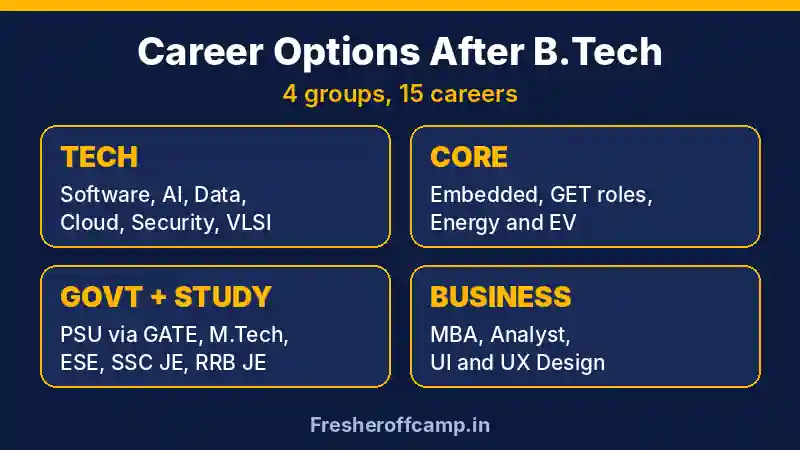
The 15 career options after B.Tech fall into four groups: tech jobs, core engineering jobs, government and higher study routes, and business roles. Tech jobs are open to every branch if you build the skills. PSU jobs and M.Tech need a GATE score. The table below shows who each career suits and how you enter it.
| No. | Career | Best for | How you enter |
|---|---|---|---|
| 1 | Software Developer | Students who enjoy coding | Off campus drives, coding tests |
| 2 | AI and ML Engineer | Strong maths and Python | Projects, internships, M.Tech |
| 3 | Data Analyst or Data Engineer | Any branch, good with numbers | SQL, Excel, Python projects |
| 4 | Cloud and DevOps Engineer | Students who like systems | Cloud certification, support roles |
| 5 | Cybersecurity Analyst | Curious problem solvers | SOC analyst trainee roles |
| 6 | VLSI and Chip Design Engineer | ECE, EEE, strong digital basics | VLSI training, design GCC hiring |
| 7 | Embedded and IoT Engineer | ECE, EEE, instrumentation | C programming, hardware projects |
| 8 | Core Engineer (GET) | Mechanical, civil, electrical | Graduate Engineer Trainee drives |
| 9 | Renewable Energy and EV Engineer | Electrical, mechanical | Trainee roles in energy and EV firms |
| 10 | PSU Job through GATE | Students who want stability | GATE score plus PSU application |
| 11 | M.Tech or MS | Students who like research | GATE or university entrance |
| 12 | Government Engineering Exams | Patient exam takers | ESE, SSC JE, RRB JE |
| 13 | MBA and Management | People and business interest | CAT or other MBA entrance |
| 14 | Business or Product Analyst | Good communicators | Analyst hiring in GCCs and consulting |
| 15 | UI and UX Designer | Creative, user focused students | Design portfolio |
Read Also:-
How to Crack an English Interview Even If Your English Is Weak:- CLICK HERE
25 Things You Should Never Say in a Job Interview as a Fresher:- CLICK HERE
Table of Contents
- Best Career Options After B.Tech in 2027: Complete Guide for Freshers
- Quick Summary: 15 Career Options After B.Tech at a Glance
- Tech Career Options After B.Tech (Open to Every Branch)
- Core Engineering Career Options After B.Tech
- Government and Higher Study Options After B.Tech
- Business and Non-Coding Career Options After B.Tech
- How to Choose the Right Career Option After B.Tech
- Common Mistakes Freshers Make With Career Options After B.Tech
- Frequently Asked Questions
- Final Words
Tech Career Options After B.Tech (Open to Every Branch)
Tech roles are the largest group of career options after B.Tech, and companies hire for them from every branch. According to the World Economic Forum Future of Jobs Report 2025, big data specialists, fintech engineers, AI and machine learning specialists and software developers are among the fastest growing jobs up to 2030.
1. Software Developer
Software development is still the most common first job for engineers. Service companies, product companies and global capability centres all hire freshers for it. Learn one language well, practise data structures and build two working projects. Then apply through off campus jobs for freshers as soon as drives open.
2. AI and Machine Learning Engineer
AI roles are growing fast, but entry level seats are fewer than the hype suggests. Companies expect Python, statistics and at least one project that solves a real problem. Many freshers start as a data analyst or software developer and move into machine learning after a year or two of work.
3. Data Analyst or Data Engineer
Data jobs suit students from any branch who are comfortable with numbers. A data analyst works with SQL, Excel and dashboards. A data engineer builds the pipelines that move data. Start with SQL, because almost every data interview tests it first.
4. Cloud and DevOps Engineer
Most companies now run their software on cloud platforms, so they need people who can deploy and maintain it. Freshers usually enter through cloud support, operations or trainee roles. A basic certification from AWS, Azure or Google Cloud plus Linux knowledge helps your resume get noticed.
5. Cybersecurity Analyst
The same WEF report lists networks and cybersecurity among the fastest growing skills. Freshers often begin as security operations centre analysts who monitor alerts and investigate threats. Networking basics matter more than your branch here, and night shifts are common in the first job.
6. VLSI and Chip Design Engineer
Chip design is one of the strongest career options after B.Tech for ECE and EEE students. A Careernet report covered by IANS counted 3,549 open roles at semiconductor design centres in India in March 2026, mostly in VLSI and system software. You need strong digital electronics, Verilog and a clear idea of design versus verification.
Core Engineering Career Options After B.Tech
Core roles are the career options after B.Tech that suit mechanical, civil, electrical and ECE graduates who want to stay in their own field. Hiring is smaller than in IT, and most companies recruit freshers as Graduate Engineer Trainees. Starting pay is often lower than in software, while experience in plants, sites and design teams builds steadily over time.
7. Embedded and IoT Engineer
Embedded engineers write the software that runs inside devices such as cars, medical equipment and home appliances. The work needs C programming, microcontrollers and basic electronics. Automotive and electronics companies hire ECE, EEE and instrumentation graduates for these roles every year.
8. Core Engineer through Graduate Engineer Trainee Programs
Manufacturing, construction, automobile and power companies run Graduate Engineer Trainee programs for freshers. You spend the first year rotating across departments before getting a fixed role. Many of these drives are announced on company career pages, so check them directly and keep your academic documents ready.
9. Renewable Energy and Electric Vehicle Engineer
The WEF report places renewable energy engineers and electric vehicle specialists among the 15 fastest growing jobs worldwide. In India, solar, battery and EV companies hire electrical and mechanical graduates for design, testing and site roles. Learn the basics of power electronics or battery systems to stand out.
Government and Higher Study Options After B.Tech
For government career options after B.Tech and for deeper subject knowledge, GATE is the main door. GATE 2027 is organised by IIT Madras and will be held on 6, 7, 13, 14, 20 and 21 February 2027. A GATE score is used for M.Tech admission and by several PSUs for recruitment.
10. PSU Job through GATE
Public sector companies in power, oil, gas and engineering use GATE scores to shortlist graduate engineers. A good score does not guarantee a job, because each PSU releases its own notification, cut off and interview. Apply to every PSU notification separately and read its eligibility rules carefully.
11. M.Tech or MS
M.Tech makes sense when you want research, teaching or a specialised role such as machine learning or VLSI. A GATE score stays valid for three years for admission. Choose the institute and specialisation first, because a general M.Tech from a weak college rarely improves your job options.
12. Government Engineering Exams
Engineers can also write the Engineering Services Examination by UPSC, SSC Junior Engineer and RRB Junior Engineer exams. Competition is heavy and preparation can take more than a year. Our guide to government job notifications explains where official notices are published.
Business and Non-Coding Career Options After B.Tech
Several career options after B.Tech need no coding at all. Management, analyst and design roles value the problem solving habit that a B.Tech gives you. These careers depend heavily on communication, so they suit students who enjoy presenting ideas, working with clients and understanding how a business earns money.
13. MBA and Management
An MBA after B.Tech opens roles in marketing, finance, operations and consulting. The return depends almost fully on the institute, so a strong CAT score matters. Many graduates work for two years first, which helps both in admission interviews and in campus placements later.
14. Business Analyst or Product Analyst
Analysts sit between the business team and the tech team. They collect requirements, study data and suggest what to build next. Consulting firms and global capability centres hire freshers for these roles. Read our guide on GCC jobs for freshers in India to see how these centres recruit.
15. UI and UX Designer
The WEF report also lists UI and UX designers among the fastest growing jobs. Designers decide how an app looks and how easily people can use it. Recruiters judge you on your portfolio, so three well explained case studies help more than any certificate.
How to Choose the Right Career Option After B.Tech
Among all career options after B.Tech, choose the one that matches your strongest skill, your money situation and the effort you can sustain for a year. Do not copy what your friends pick. Shortlist two careers, test each with a small project or a mock exam for a month, then commit to one and prepare for it fully.
- Write down what you are good at today: coding, maths, core subjects, communication or design.
- Check your finances. If your family needs income soon, take a job first and study later.
- Shortlist two options from the table above and talk to one senior working in each.
- Spend 30 days on a trial. Build one project, or solve one previous GATE paper.
- Pick one path and learn the skills it needs. Our list of the best skills to learn in 2027 can help.
- Prepare your resume and interview answers with the Interview Kit and our job hunt resources for freshers.
Once you decide, follow a clear plan to apply. Our step by step guide on how to get a job as a fresher covers resume, applications and interviews in order.
Common Mistakes Freshers Make With Career Options After B.Tech
The most common mistake is waiting for the perfect option and losing a full year without a job, a course or a serious exam attempt. Freshers also chase whatever is trending, ignore their own branch strengths and prepare for too many goals at once. A clear choice made early beats a late one.
- Preparing for GATE, CAT and placements together, and doing none of them well.
- Joining an expensive course because of an advertisement, without checking who actually got hired.
- Rejecting a first job only because the starting salary looks low.
- Believing that a non CSE branch cannot enter tech roles.
Frequently Asked Questions
Which are the best career options after B.Tech in 2027?
No single career is best for everyone. Software development, AI and data roles have the most openings, while PSU jobs through GATE offer the most stability. Choose based on your skills, your branch and how soon you need to start earning.
What are the career options after B.Tech for non CSE students?
Non CSE students can choose core roles such as Graduate Engineer Trainee, embedded, VLSI, renewable energy and EV jobs. They can also enter software, data and analyst roles by building the required skills, or take GATE for PSU jobs and M.Tech.
Is M.Tech better than a job after B.Tech?
A job is better if you need income or are unsure about research. M.Tech is better when you want a specialised role, teaching or research and can get a good institute through GATE. Many graduates work first and study later.
Can I get a government job after B.Tech?
Yes. Engineers can apply to PSUs through GATE and write exams such as the Engineering Services Examination, SSC Junior Engineer and RRB Junior Engineer. Each exam has its own eligibility, so read the official notification before applying.
When is GATE 2027 and who conducts it?
GATE 2027 is organised by IIT Madras. As per the official schedule, the exam will be held on 6, 7, 13, 14, 20 and 21 February 2027. Check the official GATE 2027 website for any change in dates.
Which jobs are growing fastest for engineers?
The World Economic Forum Future of Jobs Report 2025 lists big data specialists, fintech engineers, AI and machine learning specialists and software developers as the fastest growing jobs. Renewable energy engineers and electric vehicle specialists are also on the list.
Should I do MBA after B.Tech?
Do an MBA if you enjoy business, people and management more than technical work. The value depends heavily on the institute, so aim for a strong entrance score. Working for one or two years before the MBA usually helps.
How do I choose between career options after B.Tech?
Shortlist two options, talk to seniors working in each, and test both with a one month trial such as a small project or a mock exam. Then commit to one path. Trying many goals together is the most common reason freshers lose a year.
Can a B.Tech graduate with low CGPA get a good job?
Yes, but some large companies use a CGPA cut off for freshers, so you will have fewer drives to apply for. Strong projects, internships and skills help you get shortlisted at companies that do not filter by marks.
Final Words
There is no single best choice among these career options after B.Tech. The right one is the path you can prepare for seriously over the next twelve months. Pick it this week, start with one small step and keep applying. We post new openings daily on Fresheroffcamp.in, so check the latest jobs while you prepare.
Disclaimer: Exam dates, eligibility rules and hiring plans can change. Confirm every detail on the official website of the exam or company before you apply.





Leave a Reply