


Is the IT Job Market Over for 2026 Freshers? What the Data Really Says
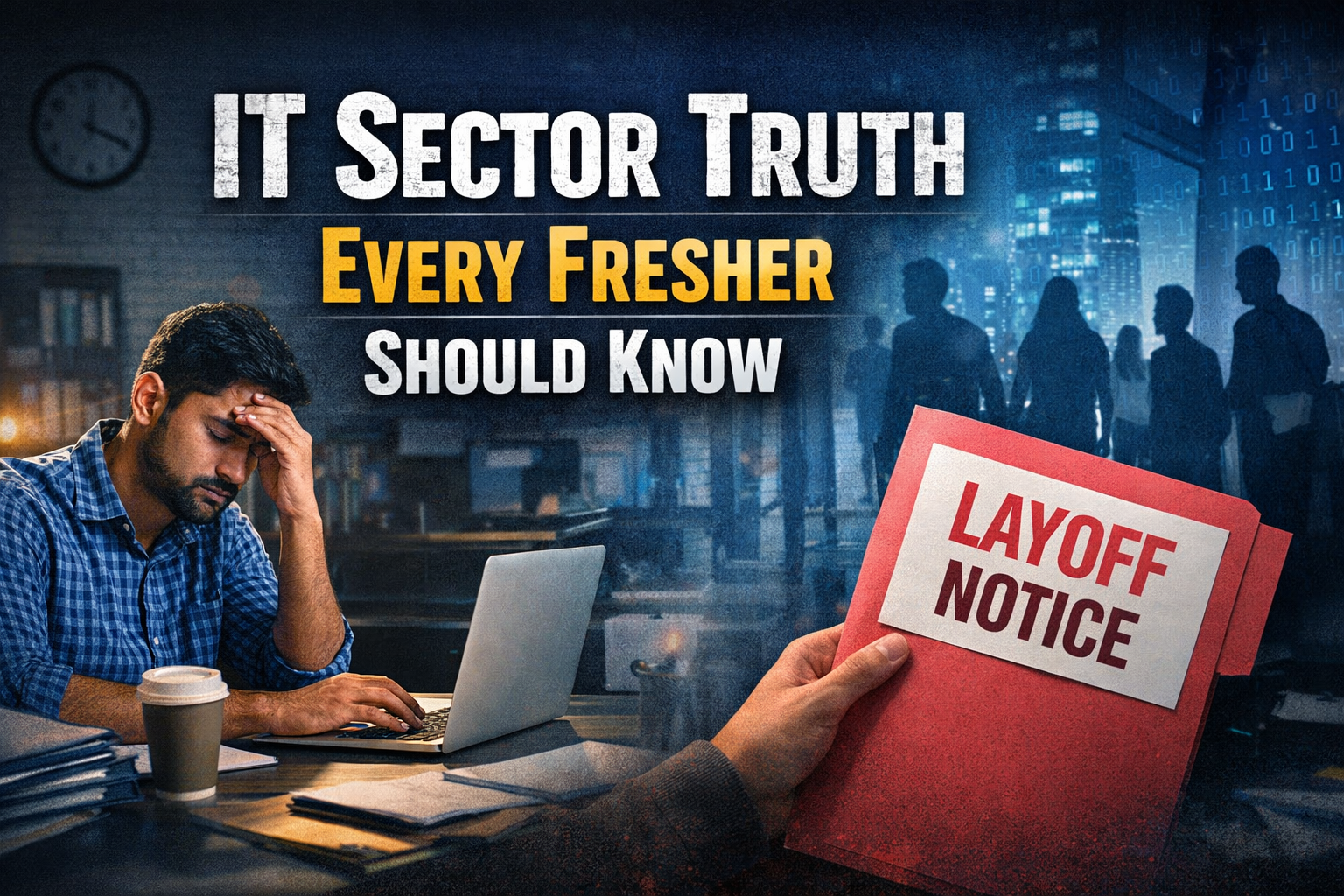
A B.Tech 2026 graduate recently posted something that thousands of freshers are feeling right now. They worked hard on their skills, learned AI, built a resume around it and applied to more than 100 jobs a day. Some companies ghosted them. Some listings looked fake. Some took interviews and then went silent. Their conclusion: “AI ruined everything for this generation”, and maybe Gen Z will end up poorer than their parents.
If you are in the 2026 batch and this sounds like your story, this article is for you. We looked at the latest hiring data from October 2026 to answer one question honestly: is the IT job market for freshers really finished, or has it changed shape?
Short answer: the IT job market for 2026 freshers is genuinely tough, and your frustration is valid. But it is not over. Fresher hiring in India is flat, not collapsing. What has changed is which entry-level jobs exist, who is hiring, and how you get noticed. Mass-applying 100 times a day is now one of the least effective ways to get a job.
What the Latest Hiring Data Says (October 2026)
The most recent Naukri JobSpeak report, released on 6 October 2026, covers hiring in September 2026. Here is what it shows:
| Indicator (September 2026, year on year) | Change |
|---|---|
| Overall white-collar hiring | +2% |
| Fresher hiring (0–3 years experience) | +1% |
| IT / software services hiring | Declined (about −4%) |
| AI/ML roles (all sectors) | +20% |
| Fresher AI/ML hiring inside IT | +19% |
| GCC (Global Capability Centre) hiring | +4% |
| Fresher hiring in Banking/Financial Services | +14% |
| Fresher hiring in Healthcare and Pharma/Biotech | +10% each |
Read that table carefully. Overall fresher hiring is not falling, it is stuck at almost zero growth. Traditional IT services hiring is weak. But fresher hiring for AI/ML roles inside IT grew almost 20 times faster than fresher hiring overall. The jobs did not disappear. They moved.
Earlier in the year the picture looked better. In February 2026, Naukri reported fresher hiring up 17% year on year, with IT fresher hiring up 8%, though most of that growth came from non-IT sectors like BPO, insurance and retail. The market has cooled since then, which is exactly when the 2026 batch started looking for jobs. Bad timing is real.
Is AI Really Killing Fresher IT Jobs?
Partly, yes. Pretending otherwise would be dishonest.
- Stanford HAI’s 2026 AI Index found that employment for software developers aged 22 to 25 in the US has dropped nearly 20% since late 2022, when generative AI tools went mainstream.
- Routine work that freshers used to do (writing boilerplate code, basic testing, simple bug fixes, documentation) is exactly the work AI coding tools now speed up.
But the same research shows something important. PwC’s 2026 Global AI Jobs Barometer, which analysed over a billion job ads, found that entry-level roles that added more senior skills (judgment, problem-solving, ownership, communication) grew 35% between 2019 and 2025, while entry-level roles that did not change fell 10%.
In simple words: AI is not removing the fresher. It is removing the fresher who can only do what AI can do. Companies now expect a junior developer to use AI tools to do the work of a slightly more experienced developer, and to understand the code well enough to catch AI’s mistakes.
So “I learned AI” on a resume is no longer a differentiator. Almost every 2026 graduate says that. What stands out is proof that you can build, debug and ship something real, with AI as your tool.
Why You Are Getting Ghosted: The Ghost Job Problem
The fake listings you are seeing are not your imagination. Researchers call them ghost jobs: postings that stay live with no real plan to hire.
- A Clarify Capital analysis of over 175,000 US job listings found roughly 1 in 7 postings were ghost jobs.
- In India, a Business Standard survey found that 73% of over 1,000 respondents had been ghosted during their job search, with IT services among the industries where this is common.
Companies keep these listings up to collect resumes for later, to look like they are growing, or because nobody bothered to close them. Every application you send to one is time you cannot get back. (Some are worse than ghost jobs: they are scams. Our guide on how to spot ghost jobs and fake job offers covers both.)
How to spot a ghost job before you apply
- The posting is very old. If it has been live for 45+ days with no “actively hiring” signal, be careful.
- The same role keeps getting reposted every few weeks with identical text.
- It is not on the company’s own careers page. Always cross-check on the official website.
- The description is vague: no team, no tech stack, no location details, no salary band.
- The recruiter email does not match the company domain (a Gmail address for a “TCS recruiter” is a red flag, and can be a scam).
- Any company asking you to pay for a test, training or “registration” is not a real employer.
The Salary Problem Is Real (But It Is Not New)
The feeling that plumbers and electricians earn more than IT freshers is common, and the numbers explain why.
TCS’s entry-level Ninja package was about ₹3.16 LPA in 2007 and is about ₹3.36 LPA in 2026, according to Business Today. Adjusted for nearly two decades of inflation, that is a large real pay cut. Meanwhile a skilled tradesperson in a metro city who gets steady work can match or beat that monthly take-home. Your observation is not wrong.
But here is the part the comparison misses: mass-hiring packages are only the floor, not the whole market.
| Fresher track (2026) | Approximate CTC |
|---|---|
| TCS Ninja | ~₹3.36 LPA |
| TCS Digital | ~₹7.0–7.3 LPA |
| TCS Prime | ~₹9.0–9.3 LPA |
| Infosys Digital Specialist Engineer | ~₹6.25 LPA + joining bonus |
| Infosys specialised roles (2026) | Up to ₹21 LPA |
The same company pays three times more to a fresher who clears a harder test. The difference between ₹3.36 LPA and ₹9 LPA at TCS is not luck or college tier. It is the Advanced section of the NQT. If you are preparing, read our guide on the TCS NQT pattern for 2026.
Also remember: IT salaries grow with experience in a way most trade incomes do not. A ₹3.5 LPA fresher who builds real skills can realistically reach ₹8–12 LPA in three to four years by switching. That ladder is slower and harder than it was in 2015, but it still exists. We cover the full picture in IT Salary Truth in India 2026.
Is Gen Z Really the Unluckiest Generation?
Every generation that graduated into a downturn felt this way. The 2008–09 batch faced the global financial crisis and frozen campus offers. The 2020–21 batch faced COVID, delayed joining dates and offer revocations. Many of them are senior engineers and managers today.
What is different now is that the change is structural, not just a temporary dip. Companies are not simply waiting for the economy to recover before hiring freshers the old way again. They are redesigning what a fresher does. That is harder to wait out, but it also means the people who adapt early have a real advantage over those who keep applying the 2019 way.
What Actually Works for the 2026 Batch: A Practical Plan
1. Stop mass-applying. Apply less, apply better
One hundred generic applications a day almost guarantees silence. Entry-level roles get the highest number of applicants per opening of any level. Instead, aim for 10–15 targeted applications a day: each with a resume tweaked for that job’s keywords, sent to a role you have verified is real, ideally with a short note to someone on the team.
2. Follow where hiring is actually growing
- GCCs (Global Capability Centres) in Bengaluru, Hyderabad, Pune and Chennai are hiring steadily, often at better pay than service companies. Read our guide to GCC jobs for freshers.
- BFSI, healthcare and pharma companies are hiring freshers for tech, data and analyst roles, and these get far fewer applicants than “Software Engineer” postings.
- AI/ML-adjacent roles: data analyst, AI testing/QA, data annotation lead, ML ops support. These are where fresher hiring grew 19%.
- Tier-2 cities have led fresher hiring growth through much of 2026.
3. Replace “I know AI” with proof
Build one or two projects that solve a real problem, deploy them, and put the live link and GitHub on your resume. A small app that real people use beats ten tutorial clones. Show that you used AI tools and also wrote tests, handled errors and can explain every line. See our list of IT skills that pay well in 2026.
4. Target the higher tier of mass recruiters
Prepare specifically for TCS Digital/Prime, Infosys DSE/Power Programmer and Wipro’s higher tracks. The coding rounds are harder, but competition is thinner and pay is two to three times higher.
5. Let people find you
Recruiters search for candidates more than they read applications. Keep your Naukri profile updated (log in regularly so you stay visible) and build a clean LinkedIn profile. Here is our guide on building a strong LinkedIn profile as a fresher.
6. Take a “bridge job” without guilt
An internship, apprenticeship, support role or QA role is not failure. Six months of real work experience changes how recruiters see you. Moving from a bridge job to a developer role is far easier than getting the developer role cold.
7. Track verified openings only
Use official career pages and trusted sources. On Fresheroffcamp, every job post links to the company’s official apply page, so you are not wasting applications on ghost listings.
Take Care of Your Mental Health
Rejection after rejection wears anyone down, and the original post said it plainly: their mental health is suffering. That is a normal reaction to a stressful situation, not a personal weakness.
- Set a daily limit on job hunting (for example, 3–4 focused hours) and stop after that.
- Measure effort, not outcomes: “I sent 12 good applications and finished one project feature” is a successful day.
- Talk to someone: a friend, family member, or batchmates going through the same thing. You are not alone in this.
- If stress, hopelessness or sleep problems keep getting worse, reach out for professional support. In India, the government’s Tele-MANAS helpline (14416) offers free mental health support in multiple languages.
Frequently Asked Questions
Is the IT job market bad for freshers in 2026?
It is tough but not collapsing. Naukri JobSpeak data shows fresher hiring in India grew only about 1% year on year in September 2026, while IT services hiring declined. However, fresher AI/ML hiring inside IT grew 19%, and sectors like banking, healthcare and GCCs are adding entry-level roles.
Has AI replaced fresher software developer jobs?
AI has reduced demand for routine junior coding work, and US data shows employment for developers aged 22–25 fell nearly 20% since late 2022. But entry-level roles that require judgment and problem-solving have grown. Freshers who use AI tools well and understand the code they ship are still being hired.
Why do companies ghost freshers after interviews?
Common reasons include hiring freezes after interviews start, roles being filled internally, high applicant volume, and ghost job postings that were never meant to be filled. It is rarely a judgment on you personally. Always follow up once politely after a week, then move on.
What is the fresher salary at TCS and Infosys in 2026?
TCS Ninja pays about ₹3.36 LPA, TCS Digital about ₹7 LPA and TCS Prime about ₹9 LPA. Infosys offers around ₹6.25 LPA for Digital Specialist Engineer and up to ₹21 LPA for specialised roles. Higher tracks require clearing harder coding tests.
How many jobs should a fresher apply to per day?
Quality beats quantity. 10–15 well-targeted applications to verified openings, each with a tailored resume, usually get better results than 100 generic ones.
Which sectors are hiring freshers in 2026 apart from IT services?
Global Capability Centres, banking and financial services, healthcare, pharma and biotech, and AI/ML-focused teams have shown fresher hiring growth in 2026, according to Naukri JobSpeak.
Final Word
The golden era of “clear an aptitude test, get a job, coast for two years” is over. That part of the frustration is fair. But the IT career itself is not over. It has become more selective and rewards people who can show real skills over people who only list them. The 2026 batch did not lose the game. The rules changed while you were still in college. Learn the new rules, aim where hiring is growing, protect your mental health along the way, and keep going.
Sources: Naukri JobSpeak (September 2026 report, published 6 October 2026, and February 2026 report); Stanford HAI 2026 AI Index; PwC 2026 Global AI Jobs Barometer; Clarify Capital ghost jobs analysis; Business Standard job-seeker survey; Business Today; company fresher hiring pages and announcements. Salary figures are approximate and can vary by role, location and year.






Leave a Reply