

How Non-IT Graduates (Mechanical, Civil, ECE) Can Get an IT Job
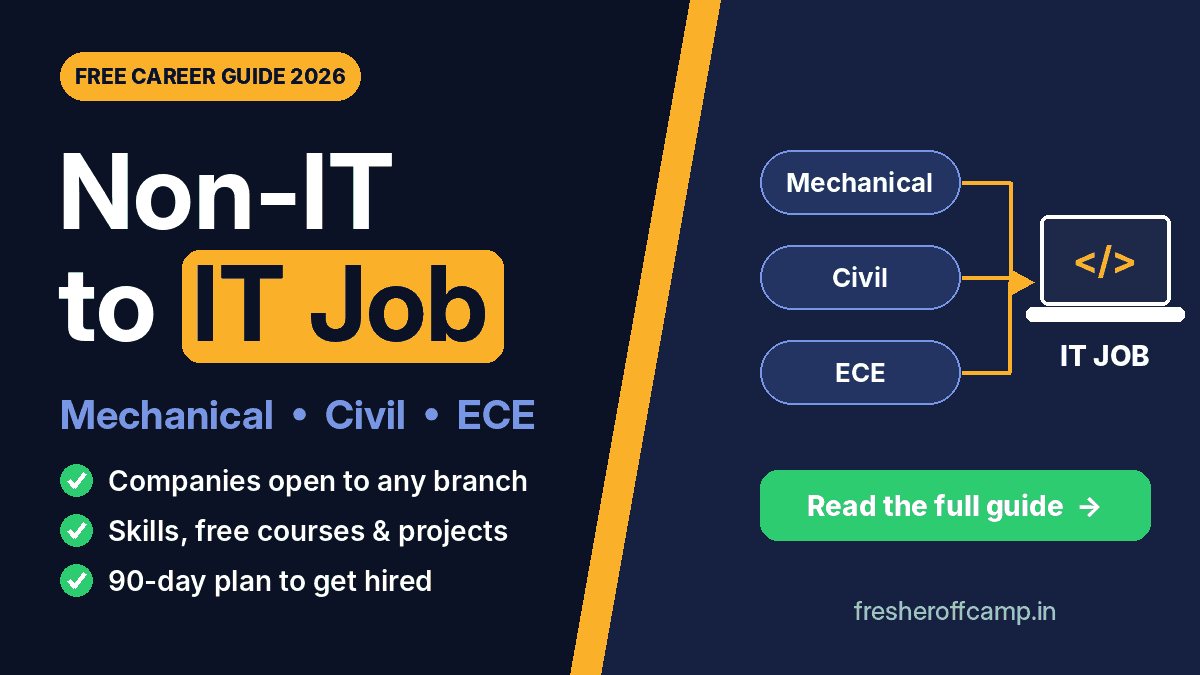
Non-IT to IT Job: How Mechanical, Civil and ECE Graduates Can Switch
Yes, a non-IT graduate can get an IT job in India. Mass recruiters such as TCS hire through tests that are open to students of any stream, so Mechanical, Civil and ECE graduates can apply. What gets you selected is not your branch: it is one programming language, aptitude practice, two or three small projects and steady applications to drives that accept your degree.
This guide explains which IT roles suit each branch, which skills to learn first, which free courses are worth your time, how to build projects that connect your degree to IT, and a 90-day plan you can follow while you apply. Everything here is written for freshers and recent graduates in India making the non-IT to IT job switch.
Last updated: 22 October 2026
Quick Overview
| Question | Short answer |
|---|---|
| Can non-IT graduates get IT jobs? | Yes. Many entry-level IT roles are open to any engineering branch; check each notification. |
| Best entry route | Mass-hiring tests such as TCS NQT, which is open to any stream |
| First skill to learn | One programming language (Python or Java) plus aptitude |
| Next skills | SQL, basic data structures, Git, and one branch-linked project |
| Roles that use your degree | CAD/PLM support (Mechanical), BIM/GIS (Civil), embedded and VLSI verification (ECE) |
| Free learning options | NPTEL (free to learn), Infosys Springboard (free courses) |
| Paid course needed? | No. A paid course can help with structure, but no company asks for one. |
| Realistic preparation time | About 3 months of daily practice before most freshers feel test-ready |
Important: branch eligibility is set by each company and can change between drives. Always read the eligibility section of the official notification before you apply.
Read Also:-
Lowe’s off campus 2026 Associate Software Engineer Hiring Guide:- CLICK HERE
Nvidia Off Campus 2026: ASIC Verification Engineer Jobs for Freshers:- CLICK HERE
Table of Contents
- Can a non-IT graduate really get an IT job?
- IT roles that fit your branch
- Skills to learn first
- Free courses and certificates
- Projects that connect your branch to IT
- A 90-day plan
- Where to apply
- Interview questions non-IT candidates get
- Common mistakes
- Frequently asked questions
Can a Non-IT Graduate Really Get an IT Job?
Yes. Large IT services companies train their freshers after joining, so their entry tests check aptitude, logical thinking and basic coding rather than your branch subjects. That is why engineers from Mechanical, Civil, Electrical and ECE regularly join them.
The clearest example is the TCS National Qualifier Test. According to the official TCS iON page, it is open to “pre-final or final year students of any stream or degree”, for candidates passing out between 2021 and 2027, aged 17 to 30. You can read the full pattern in our TCS NQT pattern 2026 guide.
Not every role is open to every branch, though. Some software developer and product roles ask specifically for CS, IT or related degrees. Your job is to find the roles that accept you, and to prove your coding skill with tests and projects instead of a degree name.
IT Roles That Fit Your Branch
You do not have to throw your degree away. Many IT roles sit close to engineering, and your branch knowledge becomes an advantage there.
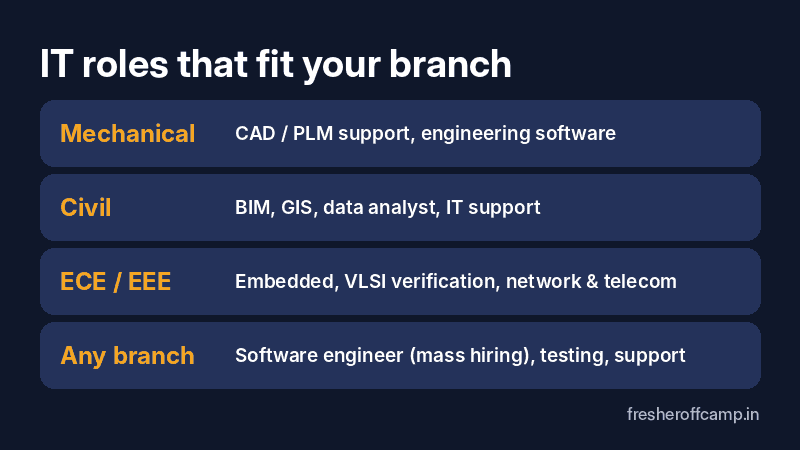
| Branch | IT roles that use your degree | Skills to add |
|---|---|---|
| Mechanical | CAD/PLM application support, engineering software testing, manufacturing data analyst | Python, SQL, basics of a PLM or CAD tool, Excel |
| Civil | BIM support, GIS analyst, construction data analyst, IT support | SQL, Excel or Power BI, basics of a BIM or GIS tool |
| ECE / EEE | Embedded software, VLSI verification, network and telecom support, IoT | C/C++, Python, digital logic, Verilog basics, networking basics |
| Any branch | Software engineer trainee in mass hiring, software testing, technical support, data analyst | One language, SQL, aptitude, communication |
Mechanical engineers
Engineering services and product companies need people who understand both design and software. Knowing how a part is designed, released and changed makes PLM and CAD support roles easier for you than for a CS graduate. If you also want to keep core options open, our Konecranes mechanical freshers post is an example of a fresher role that asks for a mechanical degree.
Civil engineers
Building Information Modelling (BIM) and Geographic Information Systems (GIS) both mix civil knowledge with software. Data analyst roles are another good bridge, because project data in construction is large and messy. SQL and one reporting tool take you a long way here.
ECE and EEE engineers
You are the closest of the three to IT. Embedded software, chip verification and networking all build on what you studied. For an example of a fresher-friendly chip role, read our Nvidia ASIC verification guide, which lists the exact skills that listing asks for.
Skills to Learn First for a Non-IT to IT Job
Learn in this order. Each skill makes the next one easier, and the first three are tested in almost every fresher drive.
| Skill | Priority | What to practise |
|---|---|---|
| Aptitude and reasoning | Must-have | Percentages, ratios, time and work, number series, puzzles; 30-45 minutes daily |
| One programming language | Must-have | Python or Java: loops, functions, arrays, strings; solve easy problems daily |
| Basic data structures | Must-have for coding rounds | Arrays, strings, hashing, sorting, simple recursion |
| SQL | High | SELECT, WHERE, GROUP BY, JOIN on a sample database |
| Git and GitHub | High | Put every project online with a clear README |
| Communication | High | Explain your projects and your switch in simple English |
| Branch-linked tool | Good to have | A CAD/PLM, BIM/GIS or embedded tool that matches your target role |
Do not try to learn five languages. Recruiters prefer a candidate who can solve problems confidently in one language over a candidate who lists many languages and struggles in all of them.
Free Courses and Certificates
You do not need an expensive course to make this switch. Two free, trusted platforms are enough to start:
- NPTEL: a joint initiative of the IITs and IISc. According to the official NPTEL site, all courses are free to enrol and learn from; the certification exam is optional and costs ₹1,000 per course. Programming, data structures and database courses are available.
- Infosys Springboard: Infosys’s free learning platform, which lists thousands of free courses, including programming and data topics.
A certificate alone will not get you hired. Use it as proof that you finished a course, and back it up with projects you can explain in the interview.
Projects That Connect Your Branch to IT
A project that uses your engineering knowledge answers the question every interviewer asks: why should we hire you instead of a CS graduate? Pick two from your branch and one general project.
| Branch | Project ideas |
|---|---|
| Mechanical | Python calculator for beam deflection or gear ratios; SQL database of parts with a simple report; dashboard of machine downtime data |
| Civil | Concrete mix or quantity estimation tool in Python; SQL and Power BI report on project costs; map of local features using free GIS data |
| ECE / EEE | Arduino or ESP32 sensor project with data logged to a file or database; simple Verilog module with a testbench; Python script that analyses signal data |
| Any branch | To-do or expense tracker web app; a Python script that automates a boring Excel task |
Put each project on GitHub with a short README: the problem, what you built, the tools you used and a screenshot. Add the links to your resume.
A 90-Day Non-IT to IT Plan
This plan assumes about 3 to 4 hours a day. If you study less, stretch each phase; do not skip one.
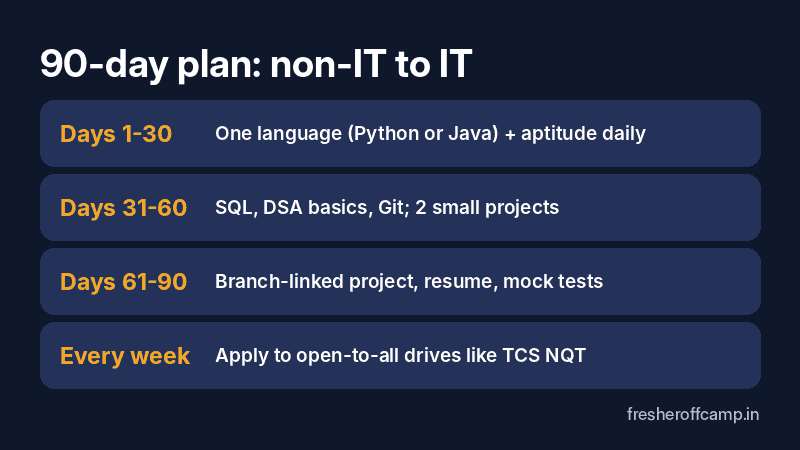
| Phase | Goal | Daily routine |
|---|---|---|
| Days 1-30 | Basics of one language and aptitude | 1.5 hours coding, 45 minutes aptitude, 30 minutes English |
| Days 31-60 | SQL, basic data structures, Git, two small projects | 1 hour problems, 1 hour project, 45 minutes aptitude |
| Days 61-90 | Branch-linked project, resume, mock tests | 1 timed mock test, 1 hour revision, interview practice |
| Every week | Apply | Apply to every drive whose eligibility matches your degree and batch |
Start applying from the first month, not the third. Tests like TCS NQT are a good benchmark: your first attempt shows exactly which sections need more work.
Where to Apply
- Open-to-all tests: TCS NQT is open to any stream. According to TCS iON, the score stays valid for two years, so one good attempt keeps working for you.
- Mass-hiring drives: large IT services companies run fresher programmes throughout the year. Many accept BE/BTech from all branches for some roles; read each eligibility table carefully.
- Core-plus-software roles: engineering services, semiconductor and manufacturing companies hire for CAD, PLM, embedded and verification roles that value your degree.
- Official career pages only: apply on the company’s own site or a portal it names. We post verified openings with official links on our Latest Jobs page.
Fraud warning: no genuine company asks freshers to pay for an interview, a test slot or an offer letter. If someone promises a “guaranteed IT job” for a fee, do not pay.
Interview Questions Non-IT Candidates Get
Expect one question about your switch in almost every interview. Prepare a calm, honest answer.
“You are a Mechanical engineer. Why do you want an IT job?”
Sample answer: “During my final year I used Python to automate calculations for my project, and I enjoyed that part more than anything else. Since then I have learned Python and SQL properly and built [your project]. My engineering background helps me understand the users of the software, and I want to grow as a software engineer.”
“Will you leave IT and go back to your core field?”
Sample answer: “No. I have spent the last few months building IT skills on purpose, and I see my long-term career here. If a project needs my engineering knowledge, I can add value there too.”
“Explain your project.”
Use four lines: the problem, what you built, one technical decision you made and why, and what you would improve next. Replace every bracket in the samples above with your real details. For more practice questions, see our Interview Kit for freshers.
Common Mistakes Non-IT Freshers Make
| Mistake | What to do instead |
|---|---|
| Learning many languages at once | Master one language before adding another |
| Only watching videos | Write code every day and solve problems yourself |
| Hiding your branch on the resume | Show it, and add branch-linked IT projects |
| Waiting to feel “ready” before applying | Apply from month one and use each test as practice |
| Paying for job guarantees | Apply only through official career sites |
| Ignoring aptitude | Practise daily; many drives filter on aptitude first |
Frequently Asked Questions
Can a Mechanical engineer get an IT job?
Yes. Tests such as TCS NQT are open to any stream, and many IT services roles accept BE/BTech from all branches. Learn one programming language, practise aptitude and build two or three projects before you apply.
Can a Civil engineer get a software job?
Yes. Civil graduates can apply to open-to-all fresher drives, and BIM, GIS and data analyst roles also use civil knowledge. SQL and one programming language are the most useful skills to add.
Is ECE considered IT or non-IT?
ECE is usually counted as a non-IT branch, but it is the closest one to IT. Embedded software, VLSI verification and networking roles build directly on ECE subjects.
Which programming language should a non-IT student learn first?
Python or Java. Python is easier to start with and is useful for data roles; Java is common in service-company training. Pick one and stay with it until you can solve easy problems on your own.
Do I need a paid course to switch from non-IT to IT?
No. Free platforms such as NPTEL and Infosys Springboard cover programming and databases. A paid course can give structure, but no company asks for one.
How long does it take to move from non-IT to IT?
Most freshers need about three months of daily practice to become test-ready. Start applying in the first month so each test shows what to improve.
Can non-IT students apply for TCS NQT?
Yes. The official TCS iON page says the test is open to pre-final or final year students of any stream or degree, passing out between 2021 and 2027, aged 17 to 30.
Will companies reject me because of my branch?
Some roles ask only for CS or IT degrees, so read each eligibility table. Many entry-level roles accept all branches, and there your test score and projects matter more than your branch.
Are certificates enough to get an IT job?
No. Certificates show you finished a course. Recruiters hire on test scores, coding ability and projects you can explain.
What should I write on my resume as a non-IT fresher?
Show your degree honestly, then list programming skills, certificates and two or three projects with GitHub links. A branch-linked project, such as a Python tool for an engineering calculation, makes your switch easy to understand.
Final Words
Your branch is not the barrier; an empty resume is. Learn one language, practise aptitude every day, build projects that connect your degree to IT and apply to drives that accept your branch. Three focused months can make a non-IT to IT job switch realistic.
Disclaimer: Eligibility rules, test patterns and hiring programmes change between drives. Always confirm the details in the company’s official notification before you apply.
Check the official TCS iON National Qualifier Test page and the official NPTEL website for the latest details.


Leave a Reply