



How to Get a Job After B.Tech Without Experience in 2027 (Complete Guide)
How to Get a Job After B.Tech Without Experience: Complete Guide for 2027
To get a job after B.Tech without experience, replace work experience with proof: two or three real projects, an internship or apprenticeship, a skills-first resume and steady applications to roles that hire freshers. Recruiters want evidence that you can do the work. This guide shows how to build it in nine steps.
This guide is for B.Tech and B.E. graduates of any branch who want a job after B.Tech without experience, including 2025 and 2026 pass outs who are still looking, and final year students who want to start early. Last updated: 22 November 2026.
Quick Summary: 9 Steps at a Glance
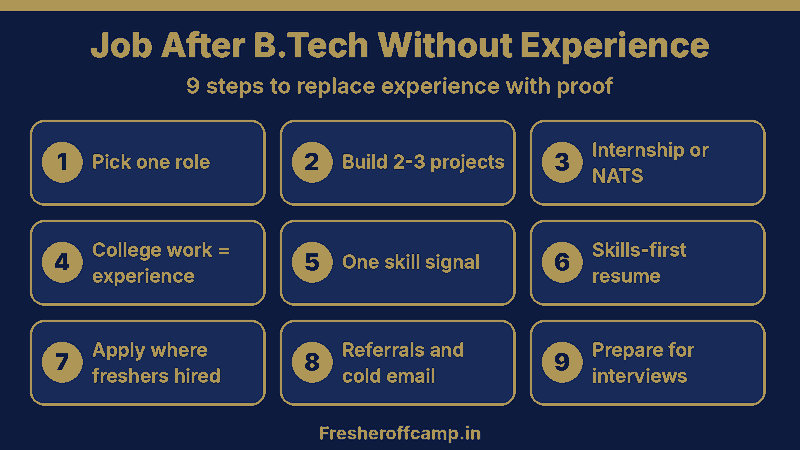
Getting a job after B.Tech without experience comes down to nine steps: pick one role, build proof projects, get an internship or apprenticeship, rewrite college work as experience, earn a skill signal, write a skills-first resume, apply in the right places, use referrals and prepare for interviews. Follow them steadily for 60 to 90 days and track which applications get replies.
| Step | What to do | Time needed |
|---|---|---|
| 1 | Pick one target job role | 1 to 2 days |
| 2 | Build two or three proof projects | 3 to 4 weeks |
| 3 | Get an internship or apprenticeship | Apply in parallel |
| 4 | Turn college work into experience | 1 day |
| 5 | Add one skill signal (coding profile or certificate) | 2 to 3 weeks |
| 6 | Write a skills-first resume | 1 to 2 days |
| 7 | Apply where freshers are hired | Every day |
| 8 | Use referrals and cold emails | Every week |
| 9 | Prepare for interviews | Ongoing |
Read Also:-
Best Career Options After B.Tech in 2027: 15 High-Growth Careers:- CLICK HERE
How to Crack an English Interview Even If Your English Is Weak:- CLICK HERE
Table of Contents
- How to Get a Job After B.Tech Without Experience: Complete Guide for 2027
- Quick Summary: 9 Steps at a Glance
- Why Companies Ask Freshers for Experience
- 9 Steps to Get a Job After B.Tech Without Experience
- Jobs You Can Get After B.Tech Without Experience
- 30-Day Plan to Get a Job After B.Tech Without Experience
- Common Mistakes Freshers Make Without Experience
- Frequently Asked Questions
- Final Words
Why Companies Ask Freshers for Experience
Companies ask for experience because they want lower risk, not because they expect a fresher to have a past job. A project, internship or apprenticeship answers the same question experience answers: can this person deliver work without constant help? Once you show that, a job after B.Tech without experience becomes realistic, and the experience line in a job post matters much less.
Many job posts written as 0 to 2 years are open to freshers. Read the full description before you skip a role. If the listed skills match yours, apply. If a post demands three or more years for a junior title, it is either a senior role or a poorly written listing, and your time is better spent elsewhere.
9 Steps to Get a Job After B.Tech Without Experience
The nine steps below work for any branch, any target role and any fresher looking for a job after B.Tech without experience. Start with steps one to three in the same week, because projects and internship applications take the longest. Steps seven to nine then run every week until you get an offer.
Step 1: Pick One Target Job Role
Choose one role, such as software developer, data analyst, QA tester, Graduate Engineer Trainee or technical support engineer. Applying to everything spreads your preparation thin and makes your resume vague. If you are unsure which role fits, read our guide to career options after B.Tech and pick one this week.
Step 2: Build Two or Three Proof Projects
Projects are the strongest way to land a job after B.Tech without experience. Build two or three small but complete projects linked to your target role. A data analyst can clean a public dataset and build a dashboard. A developer can ship a working web app. A mechanical graduate can document a design done in CAD software with clear drawings and results.
Put every project on GitHub or a simple portfolio page. Write three lines for each: the problem, what you built and the result. Recruiters spend very little time per resume, so a link they can open beats a long description.
Step 3: Get an Internship or Apprenticeship
An internship or apprenticeship turns you from a fresher with no experience into a fresher with six to twelve months of real work. Paid or unpaid, short or long, any real work counts on your resume. Apply for these in parallel with jobs. Many freshers find their first job after B.Tech without experience through an apprenticeship that turns permanent.
Engineering graduates can apply for one-year apprenticeships at PSUs, research labs and private companies through the National Apprenticeship Training Scheme (NATS) portal. Registration on the portal is required before you apply to any organisation. Stipends differ by employer. Recent 2026 notices ranged from ₹9,000 a month at NITTTR Chandigarh to ₹15,000 a month at NIT Tiruchirappalli for graduates.
Also check the PM Internship Scheme portal. Eligibility rules for degrees, age and family income are set by the scheme, so confirm on the official site whether your B.Tech qualifies before you apply.
Step 4: Turn College Work Into Experience
Your final year project, mini projects, hackathons, technical club work and industrial training are real experience. Put them under a section called Projects and Experience on your resume. Use action words and numbers where you have them, for example: built a library management app used by 40 students in my department.
Step 5: Add One Skill Signal
A skill signal is outside proof that your skill is real. For developers it can be a coding profile with regular practice. For cloud or data roles it can be one entry level certificate from a known provider. Pick one signal that matches your role, finish it, and add the link to your resume. Our list of the best skills to learn in 2027 shows which skills companies ask for.
Step 6: Write a Skills-First Resume
A resume for a job after B.Tech without experience should lead with skills and projects, then education. Keep it to one page, use a simple layout that applicant tracking systems can read, and match the keywords from the job description you are applying to. If you are applying a lot and hearing nothing back, read why freshers apply to 100 jobs and get no interview calls.
Step 7: Apply Where Freshers Are Hired
Focus on places that actually hire freshers: off campus drives, Graduate Engineer Trainee programs, global capability centres, startups, apprenticeships and company career pages. Apply within the first two or three days of a posting, because early applications are read first. You can find new openings daily on our latest off campus jobs for freshers page.
Step 8: Use Referrals and Cold Emails
A referral is often the fastest route to a job after B.Tech without experience, because an employee’s referral gets your resume read when a portal application does not. Message seniors from your college on LinkedIn, ask about their team and only then ask for a referral. You can also send a short email to a recruiter with your resume and one project link. Keep it under 120 words.
Step 9: Prepare for Interviews
Fresher interviews test your basics, your projects and your communication. Revise your core subjects, practise explaining each project in two minutes and prepare honest answers to common HR questions. Avoid the lines in our list of things you should never say in a job interview. The Interview Kit has HR answers and resume templates you can adapt.
Jobs You Can Get After B.Tech Without Experience
Several entry level roles offer a job after B.Tech without experience. These include software trainee, QA tester, technical support engineer, data analyst trainee, Graduate Engineer Trainee and apprentice roles. The table below lists each role with the proof that helps most when you apply for it.
| Job role | Branch | Best proof to show |
|---|---|---|
| Software Developer Trainee | Any branch | Two working projects on GitHub |
| QA or Software Tester | Any branch | Test cases and bug reports for a live app |
| Technical Support Engineer | Any branch | Networking or cloud basics, clear English |
| Data Analyst Trainee | Any branch | SQL practice and one dashboard project |
| Graduate Engineer Trainee | Core branches | Final year project and industrial training |
| Graduate Apprentice | All engineering branches | NATS registration and good academics |
| Design Engineer Trainee | Mechanical, civil | CAD drawings and design project report |
30-Day Plan to Get a Job After B.Tech Without Experience
A 30-day plan keeps your search for a job after B.Tech without experience moving when there is no campus placement to follow. Use the first two weeks to build proof and the next two weeks to apply hard and prepare for interviews. After 30 days, repeat weeks three and four, and add a new project every month to keep your profile fresh.
| Week | Focus | Output by the end of the week |
|---|---|---|
| Week 1 | Role, resume draft, internship and NATS applications | Target role fixed, five applications sent |
| Week 2 | First proof project | One project live with a short write-up |
| Week 3 | Second project and skill signal | Two projects, coding profile or certificate in progress |
| Week 4 | Applications, referrals, mock interviews | Twenty or more applications, three referral requests |
Once you have a plan, follow our step by step guide on how to get a job as a fresher for the full application process. Our job hunt resources for freshers include resume and outreach templates.
Common Mistakes Freshers Make Without Experience
The biggest mistake in the search for a job after B.Tech without experience is waiting to feel ready before applying. Freshers also skip internships because they want a full time job, list only marks on their resume and send the same resume to every role. Each of these keeps a strong candidate invisible to recruiters, even when the skills are there.
- Skipping every job post that says 0 to 2 years, even when the skills match.
- Doing many certificates but building no project that a recruiter can open.
- Hiding a gap year instead of explaining what you learned or built during it.
- Paying a fee to get a job. Real companies never charge you to hire you. Learn to spot ghost jobs and fake job offers.
Frequently Asked Questions
Can I get a job after B.Tech without experience?
Yes. You can get a job after B.Tech without experience because most companies hiring for entry level roles expect freshers to have no job history. They look for projects, internships, skills and communication instead. Show proof of what you can do and apply to roles that hire freshers.
How do I show experience as a fresher?
Use projects, internships, apprenticeships, hackathons, final year projects and industrial training. List them under a Projects and Experience section with clear results, and add links to GitHub or a portfolio so recruiters can check your work.
Is apprenticeship good after B.Tech?
Yes, especially if you have no experience. A one year apprenticeship gives real work, a certificate and a monthly stipend. Engineering graduates apply through the NATS portal, and some PSUs and companies hire well performing apprentices later.
What is the NATS portal?
NATS is the National Apprenticeship Training Scheme portal at nats.education.gov.in. Graduate engineers and diploma holders register there to apply for apprenticeships at PSUs, research labs and companies. Registration is required before applying to any organisation.
Which jobs can I get after B.Tech without experience?
Common options are software developer trainee, QA tester, technical support engineer, data analyst trainee, Graduate Engineer Trainee and graduate apprentice. Pick the one that fits your branch and skills, and build proof for that role.
How long does it take to get a job after B.Tech without experience?
It depends on your skills, branch and how actively you apply. Plan for at least 60 to 90 days of building projects and applying every day, and track your applications so you can see what works.
Should I do an unpaid internship after B.Tech?
A short unpaid internship can help if it gives real work and a reference, and you can afford it. Avoid long unpaid internships with no learning. Never pay an employer to give you an internship or a job.
How do I explain a gap after B.Tech in an interview?
Be honest and short. Say what you did during the gap, such as preparing for an exam, learning a skill or building projects, and what you learned. Then move the conversation to why you fit the role.
Do certificates help get a job without experience?
One relevant certificate helps as a skill signal, but it does not replace projects. Recruiters trust work they can see. Pair any certificate with at least one project that uses the same skill.
Final Words
A job after B.Tech without experience is possible when you stop treating experience as a wall and start building proof. Pick your role today, start one project this week and send your first apprenticeship or internship application. We share new fresher openings daily on Fresheroffcamp.in, so keep checking while you build. Your job after B.Tech without experience starts with that first small step.
Disclaimer: Apprenticeship stipends, scheme rules and company hiring plans can change. Confirm every detail on the official portal or company website before you apply.







Leave a Reply