


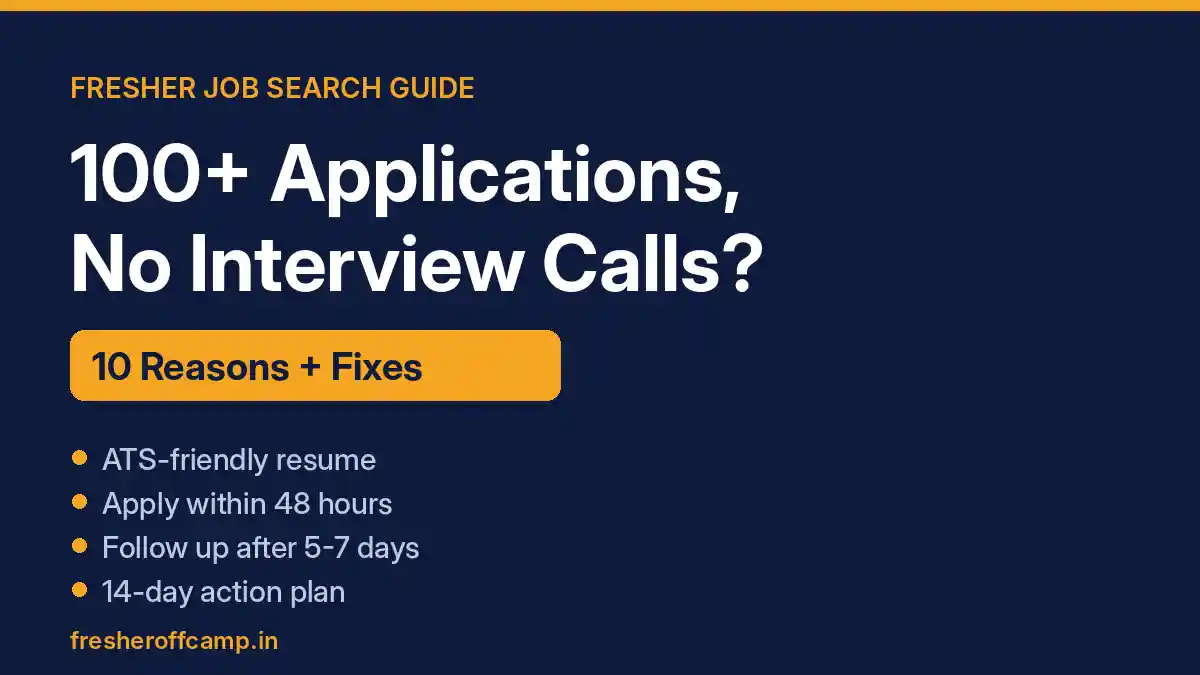
Applying for 100+ Jobs but Getting No Interview Calls? 10 Reasons Why
No Interview Calls After 100+ Applications? Read This First
If you have applied for 100+ jobs and still get no interview calls, the problem is usually not your degree or your talent. Most freshers get ignored because of a few fixable things: a resume that fails ATS filters, the same CV sent to every role, applying too late, and zero follow-up. Fix these and calls start coming.
Opening your inbox every morning and finding nothing is painful. You start doubting your college, your marks, the market. But in most cases the real reason is much simpler. Below are the 10 most common reasons, a quick self-check, and a 14-day plan to fix it.
Last updated: 4 November 2026
Quick Overview: 10 Reasons and Their Fix
| # | Reason | Quick fix |
|---|---|---|
| 1 | Resume fails the ATS filter | Simple one-column format, job keywords |
| 2 | One resume for every job | Tweak summary and skills for each role |
| 3 | Applying for roles you do not fit | Apply only where you match 60-70% |
| 4 | Applying too late | Apply within 24-48 hours of posting |
| 5 | Only using job portals | Company career pages + LinkedIn + referrals |
| 6 | Weak or no projects | 1-2 solid projects with GitHub/live links |
| 7 | Incomplete online profiles | Update Naukri and LinkedIn properly |
| 8 | Small mistakes in the application | Check email, phone, file name, typos |
| 9 | Missing HR calls and emails | Pick unknown calls, check spam daily |
| 10 | No follow-up at all | Short message to recruiter after 5-7 days |
Important: You do not need to fix all 10 at once. Most freshers see a change after fixing just the first three.
Read Also:-
Philips Off Campus 2026 Hiring Fresher For Software Technologist | Bangalore:- CLICK HERE
Qualcomm Off Campus 2026: Associate Engineer Jobs for 2027 Batch | Hyderabad, Chennai:- CLICK HERE
Table of Contents
- Quick Overview: 10 Reasons and Their Fix
- 10 Reasons You Are Not Getting Interview Calls
- Quick Self-Check: What Is Going Wrong?
- A Simple 14-Day Plan to Start Getting Calls
- Before and After: Small Changes That Work
- Frequently Asked Questions
10 Reasons You Are Not Getting Interview Calls
Recruiters move fast. In the well-known 2018 eye-tracking study by Ladders, recruiters spent an average of about 7.4 seconds on the first scan of a resume (reported by HR Dive). So your application has to make sense in a few seconds.
1. Your resume is getting rejected by the ATS
Most mid and large companies use an Applicant Tracking System (ATS) to sort applications. A fancy two-column design with icons, skill bars and photos may not be read properly, so no human ever sees it.
Fix: Use a simple one-column layout, standard headings (Education, Skills, Projects, Internships), a normal font, and PDF format. Use the exact words from the job description, like “SQL” or “customer support”, where they truly match your skills.
2. You send the same resume everywhere
A data analyst role, a Java developer role and a BPO role need different things. When one resume goes to all of them, it fits none of them well.
Fix: Keep one master resume. For each application, change only three parts: the top summary line, the order of skills, and which project comes first. This takes 5-10 minutes and makes a big difference.
3. You are applying for roles you do not fit
Many freshers click “Easy Apply” on every job that has the word “fresher” in it, including roles that ask for 2-3 years of experience or a skill they have never used.
Fix: Read the requirements first. If you match around 60-70% of them, apply. If you match 20%, skip it.
4. You apply too late
Popular fresher jobs get hundreds of applications in the first few days, and shortlisting often starts from that first batch. Apply after two weeks and the list may already be ready.
Fix: Turn on job alerts, follow company career pages, and try to apply within 24-48 hours of a job going live. This is exactly why we post fresh openings daily on Fresheroffcamp’s latest jobs page.
5. You only use job portals
Job portals are useful, but they are also where everyone applies. Many companies post roles on their own career page first, and some hire mainly through referrals or campus-style hiring platforms.
Fix: Split your effort. Apply on official career pages, use LinkedIn to reach people in the company, and ask seniors or alumni for referrals.
6. Your projects are weak or missing
As a fresher, you do not have work experience, so projects are your proof. A line like “Library Management System using Java” tells the recruiter nothing.
Fix: Build one or two projects that solve a real problem, and write what you did and what the result was. Add a GitHub or live link. For non-tech roles, a case study or a part-time job with clear results works too.
7. Your Naukri and LinkedIn profiles are incomplete
Recruiters do not just wait for applications. They also search for candidates. If your profile has no headline, no skills and an old resume, you will not show up in their searches.
Fix: Write a clear headline like “BCA 2026 | SQL, Excel, Power BI | Looking for Data Analyst roles”. Add skills, projects and your current city. Update it every few days so it stays fresh in recruiter searches.
8. Small mistakes are killing your application
A wrong phone number, an email like coolboy123@gmail.com, a file named “final_resume_new_2.pdf”, spelling mistakes, or a resume that is four pages long. Small things, but they add up.
Fix: Use a simple email (firstname.lastname), name the file “Firstname_Lastname_Resume.pdf”, keep it to one page, and ask a friend to read it once for errors.
9. You are missing the calls you do get
HR teams often call from unknown numbers. Some freshers ignore these calls, and some interview emails land in the spam or promotions folder.
Fix: Pick up unknown calls during working hours while you are job hunting. Check spam and promotions once a day.
10. You never follow up
Applying and waiting is the default for most people. A short, polite follow-up with a recruiter can bring your application back to the top, especially in smaller companies.
Fix: After 5-7 days, send a two-line message on LinkedIn or email. One clear follow-up is enough.
Quick Self-Check: What Is Going Wrong?
No interview calls at all, or calls that stop after the HR chat? Your results show where the problem is. Find your situation below.
| What you see | Likely problem | Where to focus |
|---|---|---|
| Zero calls from 100+ applications | Resume format or role fit | Reasons 1, 2, 3 |
| Calls only from consultancies or fee-based offers | Profile is visible but not strong for real companies | Reasons 6, 7 |
| A few calls, but no interview after the HR chat | Screening call answers | Practise your introduction and basics |
| Calls came earlier but stopped | Old profile, late applications | Reasons 4, 7 |
| Recruiters view your profile but do not reply | Headline and summary are not clear | Reason 7 |
If you are getting calls but failing the first HR or technical round, go through our Interview Kit for freshers with common questions and answers.
A Simple 14-Day Plan to Start Getting Calls
If you are stuck with no interview calls, do not send 20 more random applications tomorrow. Pause and fix the base first.
| Days | What to do |
|---|---|
| Day 1-2 | Pick 1-2 target roles. Read 10 job descriptions for those roles and note the common skills. |
| Day 3-4 | Rebuild your resume in a simple one-column format using those skills and keywords. |
| Day 5-6 | Improve your best project. Add results, a GitHub or live link, and a short README. |
| Day 7 | Update Naukri and LinkedIn: headline, skills, resume, city, and a short “About” section. |
| Day 8-12 | Apply to 5-8 well-matched jobs a day, mostly within 48 hours of posting. Tweak the resume for each. |
| Day 8-12 | Send 3-5 polite LinkedIn messages a day to recruiters or employees for referrals. |
| Day 13-14 | Follow up on week-one applications. Count calls, find what worked, and repeat. |
Keep a simple Google Sheet with the company, role, date applied, source and status. After two weeks you will see which sources actually give calls.
Before and After: Small Changes That Work
Resume project line
Before: Made a sales dashboard project in Power BI.
After: Built a Power BI dashboard on a public retail dataset (50,000+ rows) to track monthly sales by region; cleaned data with SQL and added filters for product and city. GitHub link included.
The second version shows tools, scale and proof. Only write numbers that are true for your project.
Follow-up message to a recruiter
“Hi [Name], I applied for the Associate Data Analyst role (Job ID 12345) on 28 October. I have worked on SQL and Power BI projects, including a sales dashboard [link]. I would be glad to be considered. Thank you for your time.”
Short and polite. No “Sir please give me a chance”, no long story. And remember: genuine companies never charge freshers for a job or interview.
Frequently Asked Questions
Why am I not getting interview calls after applying to 100+ jobs?
Usually because the resume is not ATS friendly, the same resume is sent to every role, or you apply to jobs you do not match. Fixing format, role fit and timing solves most cases.
How many jobs should a fresher apply to per day?
Around 5 to 8 well-matched jobs a day is enough. Quality matters more than quantity, so tailor your resume for each one instead of sending 50 random applications.
What is an ATS-friendly resume for freshers?
It is a simple one-column resume with standard headings, a normal font and keywords from the job description. Avoid photos, tables, icons and skill bars that software cannot read.
How long should I wait before following up on a job application?
Wait about 5 to 7 days, then send one short, polite message to the recruiter on LinkedIn or email. Mention the role, job ID and one relevant skill or project.
Does applying early really help in getting an interview call?
Yes. Many recruiters shortlist from the first batch of applications, so applying within 24 to 48 hours of a job being posted improves your chances.
Can a fresher get a job without a referral?
Yes. Referrals help, but many freshers get hired through official career pages, off campus drives and job portals with a strong, targeted resume.
Should I pay a consultancy to get interview calls?
No. Genuine companies do not charge freshers for jobs or interviews. Any request for registration or training fees in exchange for a job is a warning sign.
Final Words
No interview calls after 100+ applications does not mean you are not good enough. It usually means your applications are not reaching the right person in the right form. Fix your resume, apply smarter and earlier, follow up, and give it two honest weeks. Calls tend to follow.
Disclaimer: This article shares general job search advice for freshers. Hiring practices differ by company and role, and results vary from person to person. Always check details on the official company website before applying.
Check the latest off campus jobs for freshers on Fresheroffcamp and apply early to the roles that fit you.





Leave a Reply