


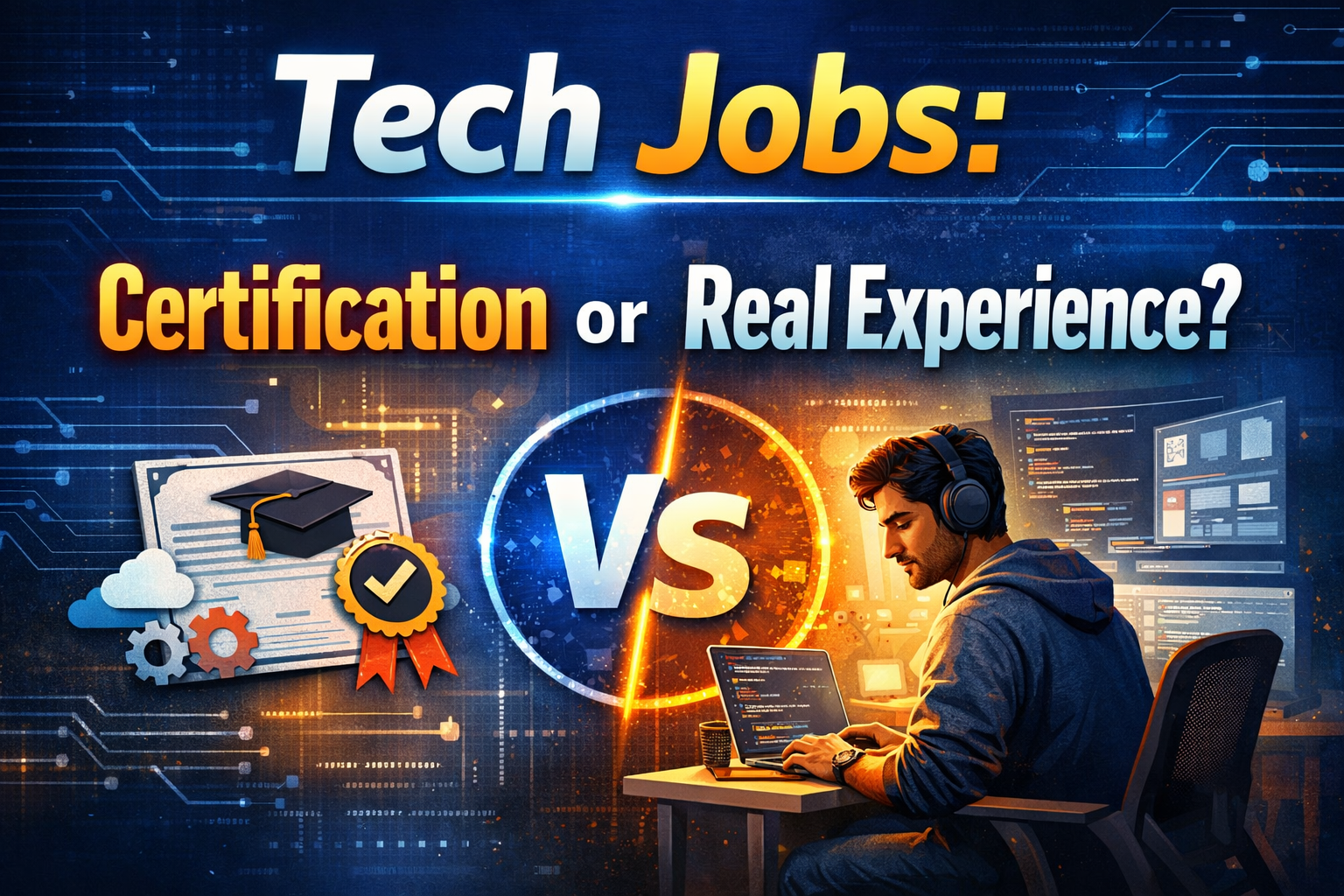
Tech Jobs: Certification or Real Experience
Certification vs. Experience-What Truly Matters in Tech?
The technology industry is growing very fast in India and across the world.
Every year, thousands of students and freshers try to enter the tech field.
Many people often ask one simple question: certification important hai ya experience?
Some people believe certifications open doors to good jobs quickly.
Others say practical experience matters more than any certificate or degree.
In reality, both play important roles in building a strong technology career.
In this article, we will understand certifications, experience, and what truly matters in tech.
What Are Certifications in the Tech Industry?
Certifications are professional documents that prove your knowledge in a specific technology field.
They are usually provided by companies, universities, or well-known training organizations.
For example, many IT professionals take certifications in cloud computing, networking, or cybersecurity.
These certifications show employers that the candidate understands certain tools and technologies.
For freshers, certifications can be very helpful in starting their career journey.
Many Indian students take courses on platforms like Coursera, Udemy, or Google certifications.
These programs help learners understand concepts and industry tools in a structured way.
Therefore, certifications can increase confidence and improve your resume value.
However, certifications alone do not always guarantee real job success.
Why Certifications Are Popular Among Indian Students
In India, competition for tech jobs is extremely high.
Lakhs of engineering students graduate every year from different colleges.
Many students feel certifications can give them an extra advantage in job applications.
Because of this belief, certification courses have become very popular in recent years.
For example, cloud certifications from AWS, Azure, and Google Cloud attract many learners.
Similarly, data analytics and artificial intelligence certifications are also trending today.
Many freshers believe certification lene se job milna thoda easy ho jata hai.
In some cases, this belief is correct because companies notice certified candidates faster.
But still, companies usually look beyond certificates when hiring technical employees.
What Does Experience Mean in the Tech Industry?
Experience means practical work done using real technologies, tools, and real-world projects.
It can come from internships, freelance work, personal projects, or previous jobs.
For example, building websites, mobile apps, or automation scripts gives valuable technical experience.
Similarly, contributing to open-source projects also improves technical understanding.
Experience teaches skills that books or courses cannot easily explain.
When developers face real problems, they learn debugging, teamwork, and problem solving.
These skills become extremely valuable when working in professional technology environments.
Therefore, experience often carries more weight during interviews and hiring decisions.
Why Companies Prefer Experience Over Certifications
Many companies prefer candidates who have solved real problems using technology tools.
They believe practical exposure shows how a person works under pressure situations.
For example, a developer who built three real applications may impress recruiters quickly.
On the other hand, someone with many certificates but no projects may struggle.
Interviewers often ask about projects, challenges, and technical decisions during interviews.
These questions help them understand the candidate’s real technical capability.
Because of this reason, experience usually becomes the deciding factor in many cases.
As many Indian developers say, “certificate se zyada kaam aana chahiye.”
When Certifications Become Very Useful
Even though experience is important, certifications also provide several advantages.
They help beginners understand technology basics in a structured learning environment.
For example, cloud certifications explain networking, security, and architecture fundamentals clearly.
Without these basics, beginners sometimes feel confused while learning advanced technologies.
Certifications also help professionals switch careers or enter new technology domains.
For instance, a network engineer may move into cloud computing using certifications.
Additionally, some companies require certifications for certain roles or promotions.
Therefore, certifications still play an important role in professional growth.
How Experience Builds Real Technical Confidence
Experience helps developers understand how technologies work in real production environments.
Projects teach how systems behave when many users access applications simultaneously.
Developers also learn teamwork, communication, and project management through real work exposure.
These skills are extremely valuable for long-term success in technology careers.
When candidates talk about real projects during interviews, recruiters feel more confident.
They can easily judge how much the person understands technology concepts.
Therefore, practical knowledge often builds stronger credibility than theoretical learning alone.
The Perfect Combination: Certification Plus Experience
The smartest strategy is not choosing between certification and experience.
Instead, the best approach is combining both for maximum career growth.
For example, a cloud certification can teach important infrastructure concepts.
Then building cloud projects can turn that knowledge into real practical experience.
Similarly, AI certifications can introduce machine learning tools and frameworks.
But working on datasets and building models creates deeper understanding.
When candidates have both certification and project experience, their profile becomes stronger.
Recruiters usually prefer such balanced candidates during hiring processes.
How Freshers in India Can Gain Experience Easily
Many freshers worry about experience because companies often ask for it.
However, gaining experience today is easier than it was ten years ago.
Students can start building projects using free tools available online.
For example, GitHub allows developers to share and collaborate on projects globally.
Internships, freelancing platforms, and open-source communities also provide practical exposure.
Even small projects like blogs, automation scripts, or mobile apps add value.
In India, many startups also give internship opportunities to passionate learners.
Therefore, freshers should focus on creating projects rather than collecting many certificates.
Technology Industry Is Changing Rapidly
The global technology industry is evolving quickly due to artificial intelligence growth.
AI is now being used in education, healthcare, and many business sectors.
For example, AI tools help doctors detect diseases faster and improve medical diagnosis accuracy.
Similarly, AI helps students learn through personalized learning systems.
At the same time, technology companies are adjusting their strategies to stay competitive.
For example, memory suppliers like Samsung and SK Hynix have increased component prices.
This situation creates pressure on companies like Apple to manage production costs carefully.
Industry analysts believe Intel may manufacture some iPhone chips using its 14A process.
Such changes show how fast the technology ecosystem is evolving globally.
Therefore, professionals must continuously learn new skills and technologies.
Technology and India’s Growing Economy
India’s economy is also supporting the growth of the technology sector strongly.
Recently, the government announced new steps to boost employment and support small businesses.
These initiatives aim to create more job opportunities for young professionals.
As a result, the demand for skilled technology workers is increasing rapidly.
Many startups and technology companies are expanding their teams across India.
Cities like Bengaluru, Hyderabad, and Pune are becoming major tech hubs.
Because of this growth, both certifications and experience will remain valuable for job seekers.
However, practical skills will continue to play a bigger role in hiring decisions.
Final Thoughts: What Truly Matters in Tech?
If we look honestly, both certification and experience have their own importance.
Certifications build strong theoretical knowledge and industry-recognized credibility.
On the other hand, experience develops practical skills and real problem-solving abilities.
Companies usually trust candidates who can demonstrate real work achievements.
Therefore, the best strategy is simple and practical for aspiring tech professionals.
Learn through certifications, but always apply that knowledge in real projects.
How Freshers Can Create a Strong LinkedIn:-https://fresheroffcamp.in/how-freshers-can-create-a-strong-linkedin/



Leave a Reply